
Author’s note:
“While the foundational concepts and arguments were conceived independently, artificial intelligence was deliberately and experimentally integrated into the drafting and development process through an iterative human-led dialogue. Throughout this collaboration, the author has maintained active editorial and conceptual control. This approach serves a dual purpose: to evaluate the practical utility of AI in academic writing as an extension of original human thought, and to invite critical reflection from the reader regarding its efficacy. As an open experiment in scholarly methodology, the resulting text remains fully subject to academic scrutiny concerning how effectively AI can enhance not only contextual richness, but the intrinsic quality of essayistic work.”
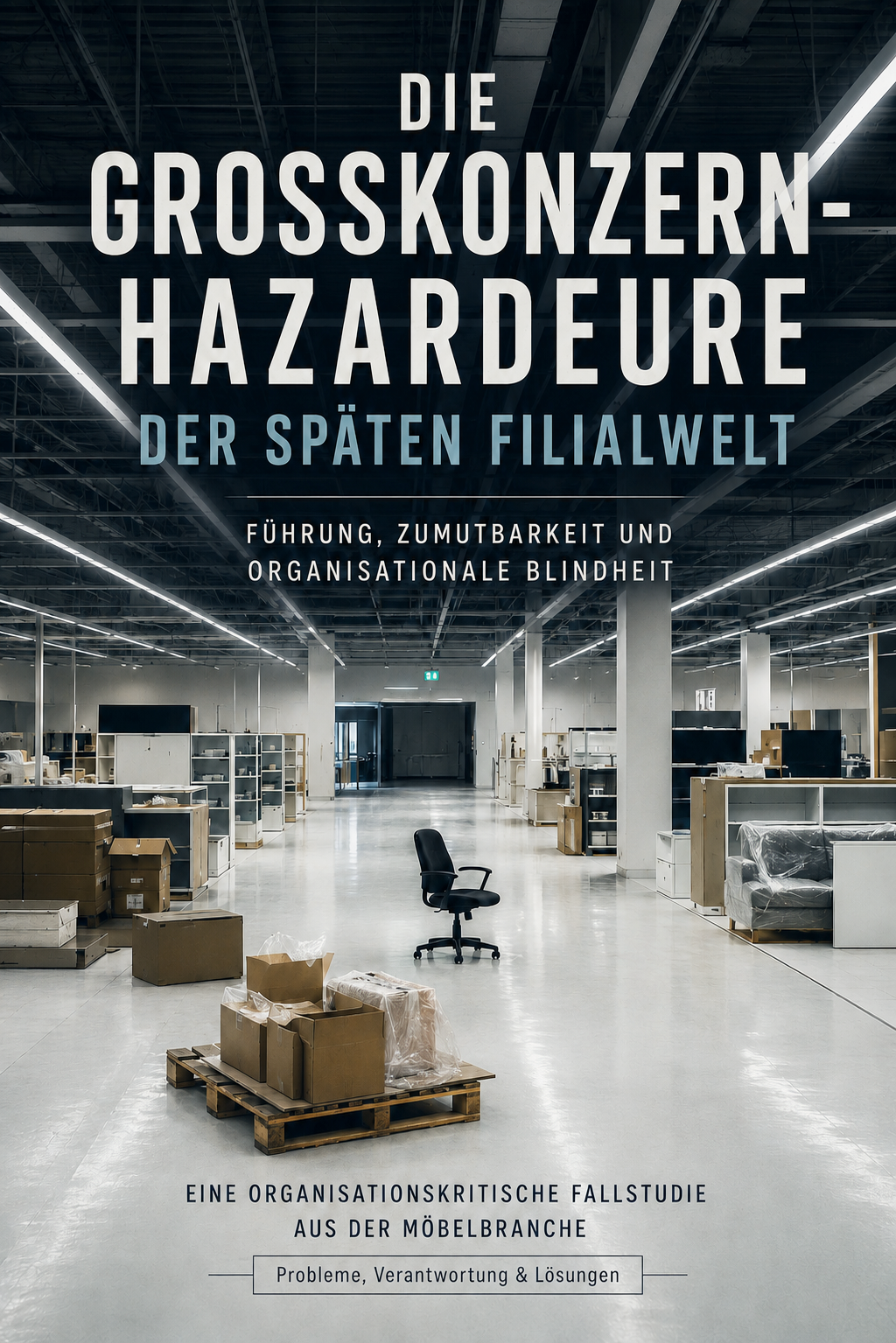
The Grand-Corporate Hazard Players of the Late Branch-Store World
Leadership, Acceptability and Organisational Blindness
This German-language organisational case study uses a conflict surrounding the opening of a furniture-store branch to examine broader failures in contemporary corporate life. It follows a chain of pressures: premature operational readiness, insufficient resources and training, logistical problems, responsibility without adequate authority, distorted overtime records, misleading system data, exclusion dynamics, termination and the long aftermath of a damaged professional separation.
Its central thesis is that organisations become dangerous when they create or tolerate structural overload, rely on local leadership to compensate for it, and later interpret the traces of that compensation as individual failure. Rather than presenting a legal accusation or personal grievance, the study reconstructs how responsibility can be shifted, simplified, documented and ultimately concentrated on one professional biography.
The branch store becomes the point where central planning, regional management, digital systems, commercial deadlines and human endurance collide. What appears to be a local personnel conflict can therefore reveal a wider form of organisational blindness: the tendency to see metrics, complaints and administrative traces more clearly than the working conditions that produced them.
The study also follows what happens after termination—through references, job applications, unemployment procedures, reputation and self-confidence—and asks whether organisations truly learn from failure or merely remove individuals while leaving damaging structures intact.