
🎬 BOON ST
Drama / Satire
A play for the screen
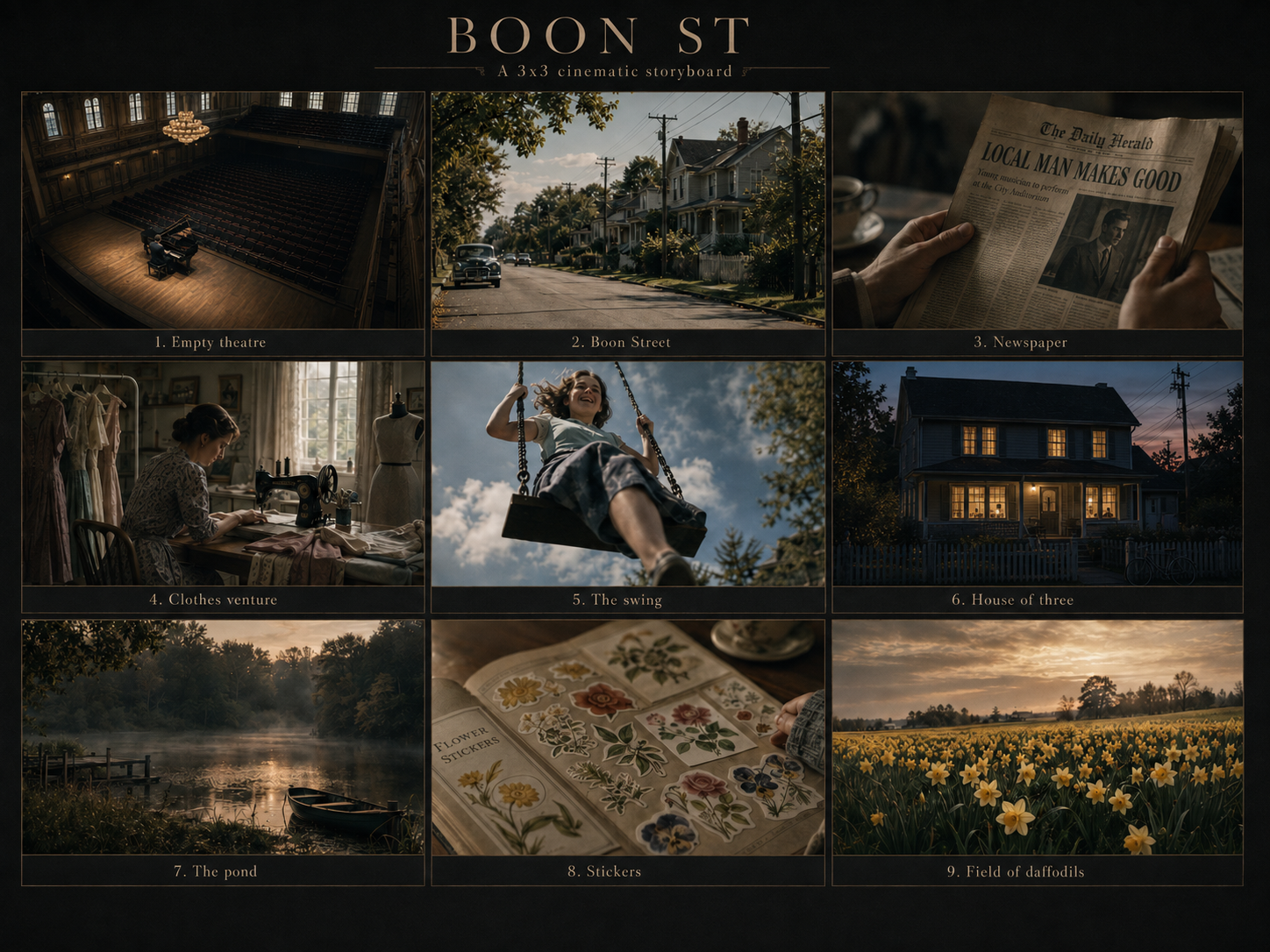
BOON ST. — TOP PROJECT QUALITIES FOR STUDIOS:
Compact Principal Cast — A concentrated ensemble of central characters, offering substantial dramatic roles while keeping principal casting requirements and associated costs manageable.
Cost-Efficient Production Potential — Much of the psychological drama unfolds within domestic environments and recurring locations, providing opportunities for economical filming. More ambitious historical sequences can be approached through selective location choices, carefully planned production design and efficient scheduling.
Strong Cinematic Impact Through Performance and Visual Storytelling — The screenplay draws much of its dramatic intensity from human relationships, shifting perspectives, psychological tension and expressive visual details rather than expensive spectacle. Its musical dimension adds further artistic possibilities.
Prestige Film Potential at a Manageable Budget — A distinctive, multi-perspective period drama combining psychological depth, historical resonance and sophisticated narrative construction, with potential appeal to international festivals, arthouse audiences and distributors seeking ambitious independent cinema.
BOON ST. — DIRECTORIAL AFFINITIES & COMPARABLE FILMS:
Stanley Kubrick — Lolita (1962)
Disturbing psychological undercurrents beneath apparently conventional social behaviour, combined with unsettling irony and a critical examination of desire, power and moral self-deception.Ingmar Bergman — Fanny and Alexander (1982)
The complexity of domestic relationships, childhood perception, intergenerational tensions and the gradual revelation of emotional realities within an extended family narrative.Todd Haynes — Far from Heaven (2002)
Meticulous period atmosphere, carefully composed domestic environments and the contrast between outward social respectability and deeply repressed emotional conflicts.Joe Wright — Atonement (2007)
Shifting perspectives, the lasting consequences of misunderstanding, the interaction between private lives and historical events, and the cinematic transformation of memory and guilt.
Cinematic positioning: An ambitious, multi-perspective period drama combining psychological complexity, social observation, disturbing irony and a carefully structured interplay of image, memory, music and dramatic performance.
Production Potential
The broader scope of production advantages and cinematic opportunities:
Compact Principal Cast — The screenplay centres on a small group of essential characters, offering substantial dramatic roles while keeping principal casting requirements manageable. The concentrated ensemble allows performances and psychological interaction to carry much of the film's dramatic weight.
Concentrated and Recurring Locations — A significant part of the narrative unfolds within a family home and its immediate surroundings, including domestic interiors, the garden, the pond and adjoining spaces. These recurring environments offer opportunities for efficient scheduling, location continuity and economical production design.
Manageable Production Budget — Despite its historical dimensions and narrative ambition, much of the film's emotional and psychological intensity derives from dialogue, observation, gesture and character interaction rather than expensive spectacle. With careful planning of the more elaborate sequences, the production offers opportunities for substantial cinematic quality within a controlled budget.
Efficient Use of Production Design — The central household can function as a carefully developed principal set, allowing multiple scenes and perspectives to be filmed within the same environment. Recurring objects, furnishings and spatial arrangements gradually acquire new significance, enhancing the cinematic experience without requiring continuous changes of location.
Distinctive Multi-Perspective Narrative Structure — The interconnected perspectives of Aiden, Irit and May provide an unusual dramatic architecture. The same domestic world is experienced differently by each character, allowing the film to generate complexity through perspective, editing and performance rather than an ever-expanding cast or location structure.
Strong Opportunities for Character-Driven Performances — The screenplay offers psychologically demanding roles involving emotional repression, childhood perception, desire, moral ambiguity, memory and interpersonal conflict. This creates opportunities for distinctive performances capable of attracting actors interested in substantial dramatic material.
Historical Depth with Selective Production Requirements — The Second World War, its aftermath and the changing social environment provide the narrative with historical resonance. While the wartime sequences require dedicated resources, their production can be approached through selective reconstruction, carefully chosen locations, controlled visual effects and focused dramatic representation.
Powerful Visual Storytelling Through Everyday Environments — Domestic interiors, architectural details, changing seasons, natural light and recurring visual motifs provide the foundations for a sophisticated cinematographic language. Ordinary objects and spaces become expressive elements within the narrative, allowing psychological depth to emerge through images rather than exposition alone.
Integrated Musical and Rhythmic Potential — Music plays an important role in the screenplay's wider artistic conception, particularly through the framing narrative involving the composer Aviv Sanftleben. Musical development, sound design and editing can reinforce the relationships between memory, emotional tension and changing narrative perspectives, contributing to a distinctive audiovisual identity.
Internationally Recognisable Human Themes — Although rooted in a particular historical and domestic environment, the film explores universal experiences: marriage, childhood, loneliness, sexuality, family expectations, guilt, moral responsibility and the difficulty of understanding others. These themes offer opportunities for international audience engagement beyond the film's immediate cultural setting.
Arthouse and Prestige Cinema Potential — The combination of psychological depth, historical atmosphere, formal narrative ambition and performance-driven storytelling offers potential appeal to international film festivals, independent distributors and audiences interested in sophisticated literary adaptations and character-centred cinema.
High Artistic Ambition with Flexible Production Planning — The screenplay combines an intimate dramatic core with selected sequences of greater historical and visual scale. This distinction makes it possible to concentrate production resources where they will have the greatest cinematic impact, preserving the project's artistic identity while developing a realistic shooting schedule and budget.
Overall Production Positioning
Boon St. offers an opportunity to develop an ambitious, psychologically sophisticated period drama around a comparatively compact principal cast and a concentrated set of recurring locations. Its multi-perspective structure, expressive domestic environments, substantial acting opportunities and musical dimension provide a distinctive cinematic identity.
The project's principal production advantage lies in the relationship between its concentrated dramatic core and its wider artistic ambition. With appropriate planning for the historical and location-intensive sequences, Boon St. could combine the production efficiency of character-driven independent cinema with the visual and emotional ambitions of an internationally oriented prestige film.
Presentation video
-
Presentation video -
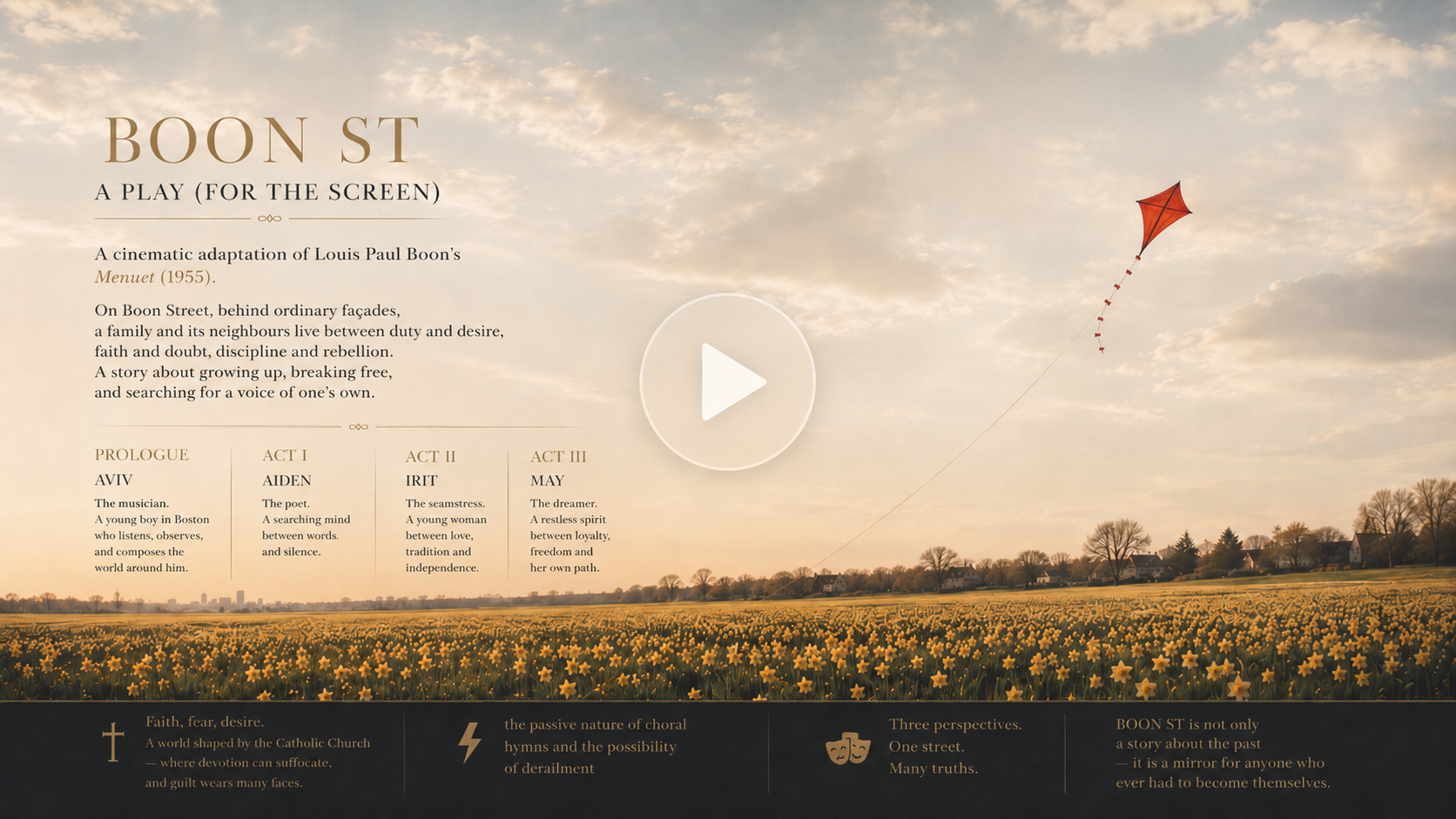
https://youtu.be/MtuDy3jGM
An English-language screen adaptation inspired by Louis Paul Boon’s Menuet
Boon St is an English-language literary screenplay by Filip Firlefijn, freely based on and developed from Louis Paul Boon’s 1955 novel Menuet.
Rather than translating the novel scene by scene, the screenplay takes one of Boon’s most distinctive artistic principles as its point of departure: several people inhabit the same reality without ever possessing the same understanding of it. The physical world remains one, but what each character sees, knows, remembers and interprets is different.
That principle becomes the cinematic architecture of Boon St.
The main story unfolds through three extensive and intersecting perspectives — Aiden, Irit and May. Events return from another position. Gestures acquire different meanings. Something barely noticed in one perspective may become decisive in another. The spectator gradually knows more, but never reaches a completely omniscient position.
The screenplay therefore turns perspective itself into drama.
From Boon to Boston
The adaptation relocates the dramatic world of Menuet to postwar Boston, with a framing movement that also reaches New York.
This is not intended as a cosmetic Americanization of a Flemish novel. The new setting creates another historical field in which Boon’s themes — intimacy, sexuality, authority, isolation, social expectation, violence, memory and the difficulty of truly knowing another person — can develop independently.
War remains present at the edges of ordinary life. Large historical forces coexist with bedrooms, kitchens, gardens, radios, newspapers, household work and neighborhood routines. History is immense; experience remains local.
Although geographically American, Boon St is productionally flexible. Much of the screenplay takes place in interiors, domestic spaces and other controlled environments. Boston and New York remain essential to the fictional world, but a substantial part of the production could be realised in studio or through carefully selected substitute locations.
A literary adaptation with an identity of its own
The relationship with Louis Paul Boon remains deliberately visible.
The title Boon St sounds like an address while keeping Boon’s name inside the new work. The adaptation preserves the importance of perspective, ambiguity, uncomfortable realism and Boon’s refusal to reduce human beings to morally tidy abstractions, while freely transforming setting, characterization, historical context and cinematic structure.
Its relationship to Menuet is therefore both faithful and independent.
The screenplay does not attempt to reproduce Boon’s literary techniques literally. It asks what those techniques can become in cinema.
How can perspective become editing?
How can repetition change meaning?
How can the same event remain physically identical while becoming emotionally different?
And how much can an audience ever really know about the people it is watching?
The minuet
Music forms part of the screenplay’s architecture rather than merely its soundtrack.
A minuet moves in triple time, and Boon’s original three-part structure already suggests a kind of literary dance. Boon St carries that principle into the screenplay: characters approach and withdraw, scenes recur, viewpoints cross, and moments that initially appear isolated gradually become part of a larger counterpoint.
A fourth perspective, introduced through composer Aviv Sanftleben, frames the three principal viewpoints without solving them. His presence broadens the question from What happened? to something more difficult:
What does it mean to tell what happened when nobody could ever have known all of it?
Two production versions
The project currently exists in two closely related forms.
The original authorial version remains the principal and artistically preferred version of Boon St. Certain material carries a parental advisory because the adaptation deliberately retains some of the discomfort, sexual complexity and transgressive edge that belong to the dramatic world and, more broadly, to the literary identity from which the project developed.
These elements are not included merely for provocation. They form part of the screenplay’s treatment of desire, power, misunderstanding, moral instability and human contradiction.
At the same time, a separate production/compliance version has already been prepared. It offers a lighter alternative where safeguarding, casting, age classification, distribution or other production requirements make adaptation desirable.
The lighter version is not intended to supersede the original. It exists as a practical production option.
The original authorial version therefore remains the central artistic point of departure, while specific production choices remain open to discussion with producers, directors, casting professionals, intimacy coordinators and distribution partners.
Between literature and cinema
Although conceived for the screen, Boon St has deliberately retained a literary density that also allows the screenplay to be read as a dramatic work in its own right.
Its aim is not to strip literature away in order to become filmable, but to discover how literary complexity can become cinematic:
prose becomes mise-en-scène,
perspective becomes editing,
repetition becomes suspense,
and incomplete knowledge becomes structure.
The project ultimately remains rooted in a very simple situation:
people live close to one another,
observe one another,
misunderstand one another,
and nevertheless continue trying to know one another.
One house.
One reality.
Several perspectives.
Boon St.
Boon St. — Overview of Contacted Film Production Companies, Studios and Audiovisual Organisations:
Menuetto Film
Eyeworks Belgium
De Mensen
Dingie
VRT
Viking Film
Pupkin
Kaap Holland Film
Submarine
Topkapi Films
Lemming Film
Hugofilm Features
Zodiac Pictures
C-Films
Contrast Film
Turnus Film
Dschoint Ventschr Filmproduktion
Zero Gravity Management
Animal Kingdom
Stay Gold Features
WERK
Footprint Films
A to Z Films
The Bureau
… and some already in 2014/16