
Author’s note:
“While the foundational concepts and arguments were conceived independently, artificial intelligence was deliberately and experimentally integrated into the drafting and development process through an iterative human-led dialogue. Throughout this collaboration, the author has maintained active editorial and conceptual control. This approach serves a dual purpose: to evaluate the practical utility of AI in academic writing as an extension of original human thought, and to invite critical reflection from the reader regarding its efficacy. As an open experiment in scholarly methodology, the resulting text remains fully subject to academic scrutiny concerning how effectively AI can enhance not only contextual richness, but the intrinsic quality of essayistic work.”
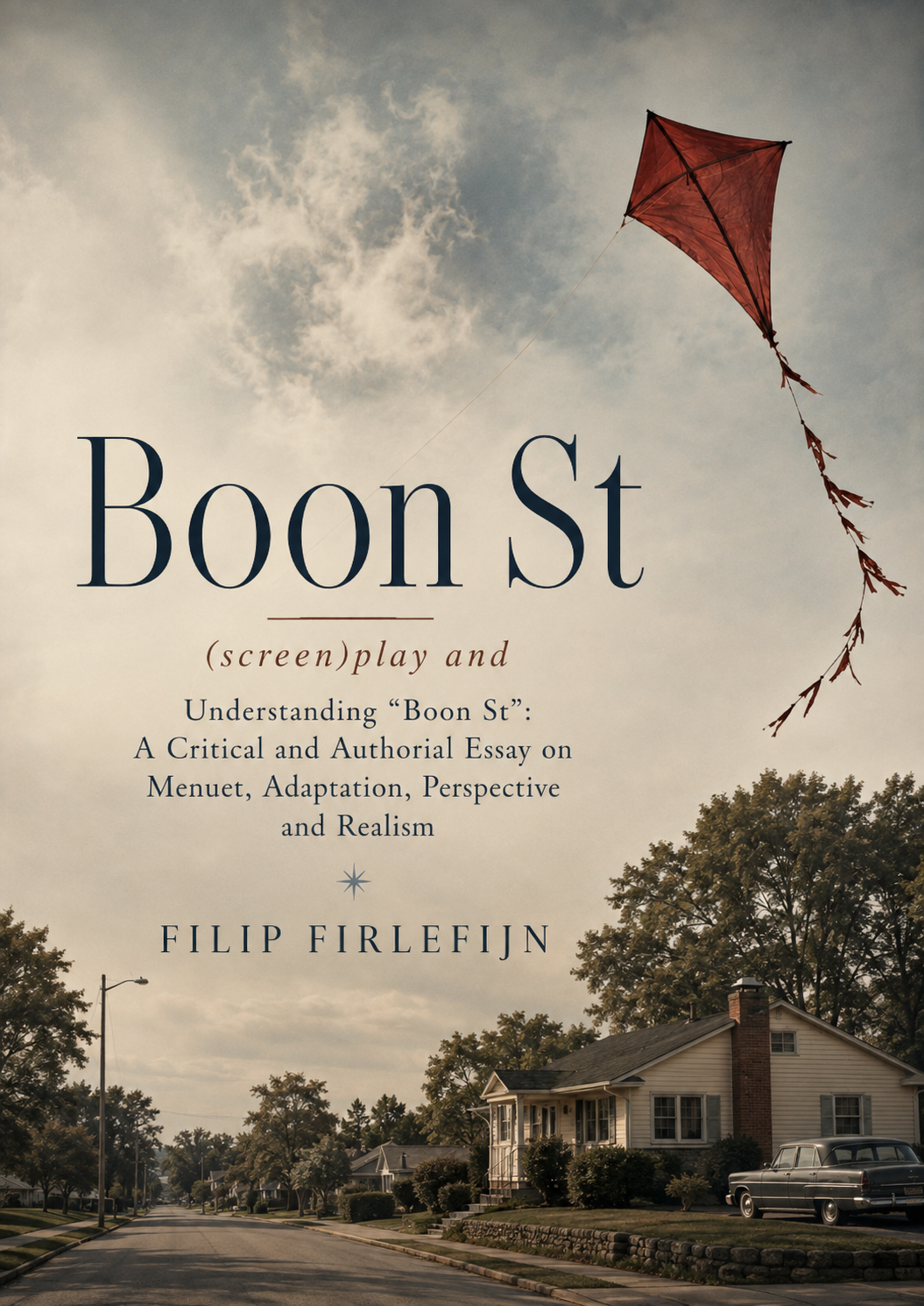
Understanding “Boon St”
A scholarly authorial essay on adaptation, perspective and realism
Boon St. is a creative-critical project that brings literature, cinema and reflective essay writing together. Inspired by Louis Paul Boon, it explores how classic texts can be reimagined for contemporary audiences without losing their moral force, psychological depth or social intelligence.
At its core lies adaptation as interpretation. Rather than simply transferring a novel to screen, Boon St. works through image, rhythm, silence, framing and perspective. It experiments with multi-perspective storytelling, fractured viewpoints, dark humour and emotional realism, showing how literary material can acquire new life in cinematic form.
The accompanying essay broadens this into a philosophical question: what remains of a work when its form changes? How can fidelity mean creative truth rather than literal reproduction? And what does a modern audience need in order to experience the urgency of older texts?
The project also reflects on Belgian and European cultural identity, postwar realism, class, intimacy and the ethics of ordinary life—concerns central to Boon’s work and still relevant today. In a culture of rapid production and rapid forgetting, Boon St. argues for careful transformation: adaptation as an act of intelligence, respect and renewal, in which the past is not repeated but made present again.