
🎬 PROVIDENCE
Psychological drama/thriller - mystery/crime
Screenplay · English · Feature film
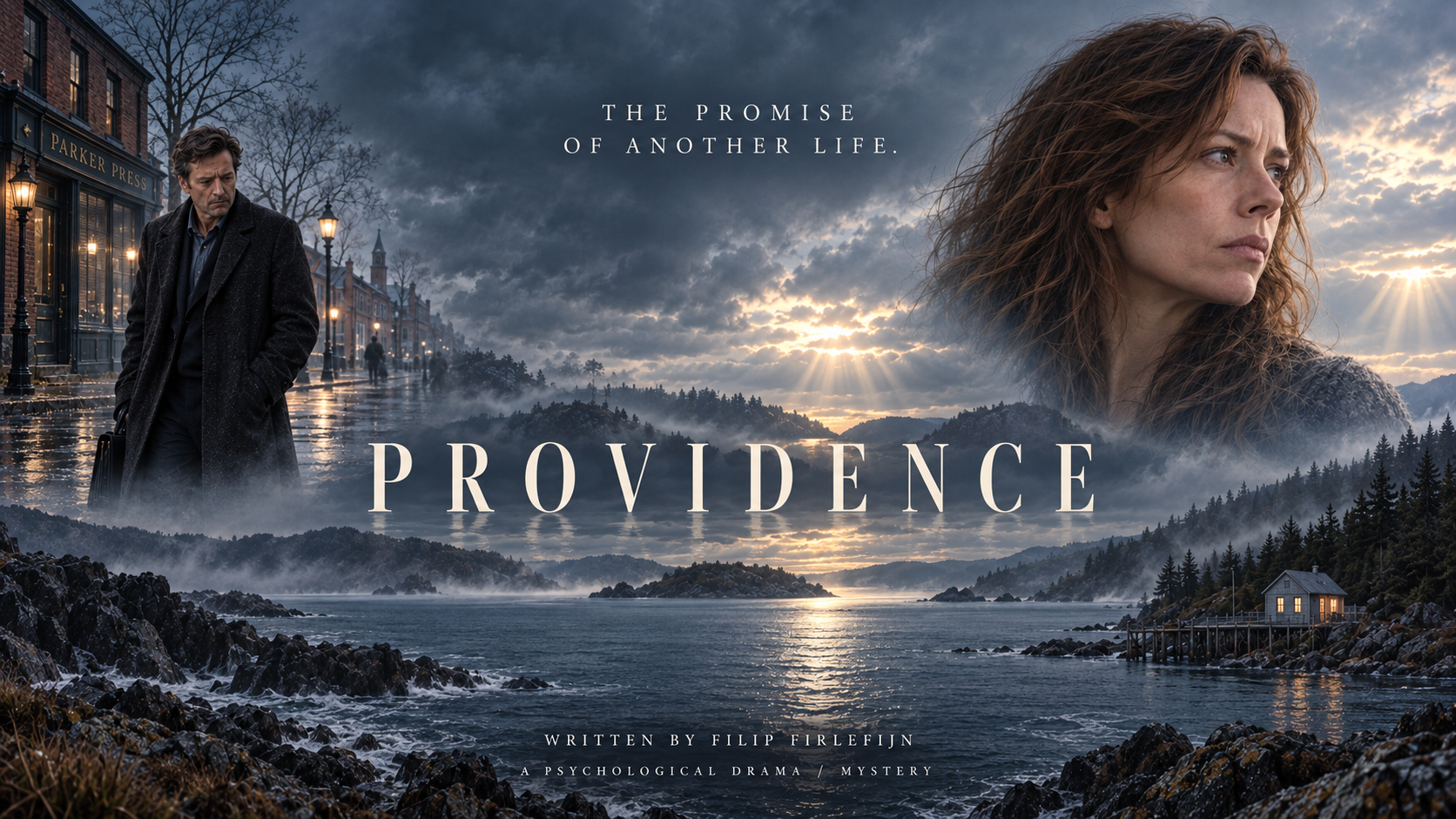
TOP PROJECT QUALITIES FOR STUDIOS:
Compact cast — A focused ensemble with limited casting requirements.
Production-friendly locations — Few, accessible settings with minimal logistical complexity.
Cinematic power of natural landscapes — Striking environments that deliver high visual impact without extensive production costs.
Strong commercial potential at a modest budget — A cost-efficient production with the potential for substantial box-office returns.
DIRECTORIAL AFFINITIES & COMPARABLE FILMS:
Martin Scorsese — Shutter Island (2010)
The gradual transformation of an investigation into a disturbing psychological mystery, where the search for truth increasingly destabilises the investigator's understanding of reality.David Lynch — Mulholland Drive (2001)
Fractured identities, dreamlike transitions and the unsettling coexistence of apparently incompatible versions of reality.Denis Villeneuve — Enemy (2013)
Psychological doubling, suppressed trauma and an atmosphere in which ordinary environments gradually acquire disturbing symbolic significance.Atom Egoyan — The Sweet Hereafter (1997)
Layered psychological storytelling, the enduring consequences of trauma and the expressive relationship between human vulnerability and Canadian landscapes.
Cinematic positioning: An atmospheric psychological mystery combining investigative suspense, fractured identities and emotionally charged landscapes, with an emphasis on ambiguity, visual storytelling and the instability of perceived reality.
Production Potential
A focused cast
Two central roles carry much of the narrative, supported by smaller speaking parts. Strong opportunities for performance without requiring a large ensemble.Accessible settings
Homes, offices, cafés, hotel rooms and small shops provide the foundation. Many interiors could be filmed in existing locations with modest dressing.Flexible location planning
The story spans Rhode Island, Québec and Newfoundland. A carefully selected production base, supported by targeted exterior shoots, could reduce travel and company moves.Photography as a primary asset
Water, mist, coastal landscapes and available light establish the film’s visual identity. Selective landscape photography can give a modest production a substantial sense of scale.Editing as a storytelling strength
Shifts in perspective, visual echoes and recurring details create opportunities for precise, expressive editing. The material invites an editor to shape suspense through timing, juxtaposition and recognition.Sound-driven atmosphere
Wind, water, distant voices and everyday interior sounds can deepen tension through carefully designed soundscapes.Limited reliance on spectacle
The dramatic emphasis falls on encounters, observation and psychological tension. Selected stylised moments would require planned effects, while much of the film can be achieved practically.A scalable budget approach
A contained adaptation could prioritise the central performances, consolidate supporting roles and locations, and reserve resources for essential landscape sequences.Key development consideration
The current screenplay is extensive. Its low-budget potential depends on a focused feature-length adaptation and careful planning of travel, weather, water, animal and specialist scenes.The production proposition
A performance-led mystery whose strongest production assets are its cast, photography, editing and sound—offering scope for an economical film with a distinctive cinematic identity.
Logline
When a reclusive printer dies, former detective Philip Farrell sets out to trace a missing heir. His search carries him from Rhode Island into the remote landscapes of eastern Canada, drawing him into lives whose private truths resist the certainty of his investigation.
Vidéo Promo I : https://youtu.be/L0idg50YcQc
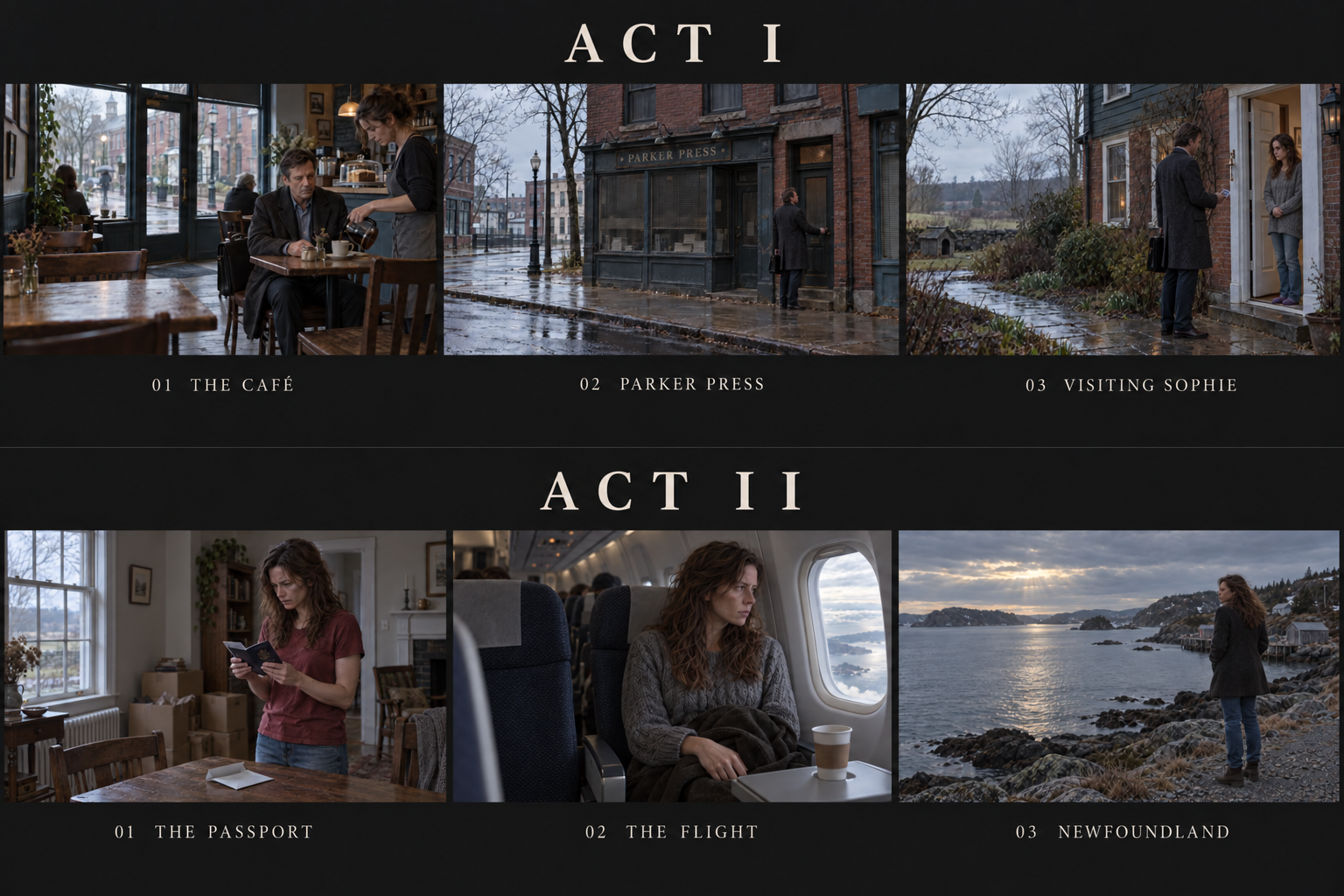
The Film
Providence, Rhode Island, 2011.
Philip Farrell earns his living finding the people the dead have left behind. It is work that suits his habits: examining records, following addresses, asking questions. Grieving his wife, he finds a measure of continuity in other people’s unfinished affairs.
The estate of Roland Parker appears to offer another such assignment. A printer with few apparent connections, Parker has left behind a building, the remains of his business, and unanswered questions about his family.
Among the traces of his life is a book by Sophie Winter, a former teacher living in rural Rhode Island. For Philip, it is a possible lead. For Sophie, its publication belongs to a past she would rather keep at a distance.
As the search extends northward, ordinary encounters acquire an unsettling weight. What can a photograph establish about a person? What survives in a document? And how much of another life can anyone reconstruct from what has been left behind?
Providence brings the patient curiosity of a detective story into contact with the intimate uncertainties of grief, memory and self-preservation.
A Place, a Promise
The title names the city where the story begins. It also suggests the possibility of a guiding order: the hope that an encounter, an unexpected opportunity or a journey might arrive for a reason.
That hope runs through the film.
Its characters seek security, recognition, companionship and room to begin again. Money has practical consequences. A book can carry an intensely personal investment. An offer of help can matter far beyond what the person making it understands.
Providence explores the difficult space between wanting to help someone and believing one knows what their life should become.
People and Their Absences
Philip Farrell
A former police detective whose professional attentiveness coexists with unresolved grief. He is accustomed to making connections between facts, yet his own loneliness enters quietly into the way he sees other people.Sophie Winter
A former teacher and the author of a single published novel. Guarded, perceptive and isolated, Sophie has invested much of herself in writing. Her encounters with Philip bring two very different ways of understanding a life into the same room.Francine Parker
The missing heir at the centre of Philip’s assignment. Her absence raises a question that reaches beyond the investigation: how faithfully can the accounts of others represent someone who is not there to speak?Roland Parker
A printer whose death sets the search in motion. His work has preserved other people’s words, while his own life remains difficult to read.
Landscape and Atmosphere
The film moves from the rivers, former industrial streets and damp countryside of Rhode Island to the snow and mist of Québec’s Saguenay region and the exposed coastline of Newfoundland.
These places have a physical presence: wet roads, cold platforms, modest hotel rooms, working harbours and houses shaped by the weather. Travel takes time. Conversations unfold over coffee. The search proceeds through the practical details of getting somewhere and finding someone willing to talk.
Water connects these environments. Rivers, marshes, snow, bays and dark inland ponds establish a visual continuity across the distances.
The landscapes offer space and beauty, but also isolation. A place that seems to promise refuge may feel very different to someone who has to live there.
Cinematic Approach
The visual language begins in close observation: subdued daylight, ordinary interiors, restrained gestures and the pauses within conversation.
Unease gathers through repetition, framing and changes of context. A face, an object or a familiar space can acquire a different significance without announcing the moment of change.
Sound gives these environments their own presence: the hum of a café refrigerator, a dog heard outside, railway noise, wind along a wharf. Silence leaves room for what the characters cannot comfortably say.
The film asks the audience to look closely, while allowing their understanding of what they see to remain open.
Artistic Intention
Providence explores the need to make a life bearable—and the vulnerability that need can create.
Grief, manipulation, financial insecurity and the desire for companionship shape its characters’ choices. Writing and art belong to this same world: intimate attempts to give experience a form that another person might recognise.
The mystery provides a way into these lives. Its emotional force comes from the difficulty of knowing another person, particularly when care, desire and self-interest become entangled.
At its heart is a question:
What do we hope to find when we imagine a life elsewhere?
Providence — Overview of Contacted Film Production Companies, Studios and Audiovisual Organisations
Project information and proposals for potential collaboration regarding Providence, the English-language North American adaptation of Donkere Meren, were sent to the following film production companies, studios and audiovisual organisations in Belgium, Canada and the United States:
De Mensen — Belgium
Caviar — Belgium / United States
Eyeworks Belgium — Belgium
Strange Company Productions — Canada
JACL Films — Canada
Black Fawn Films — Canada
Vezina Films — Canada
White Pine Pictures — Canada
Cricket Shift Productions — Canada
Lakeport Pictures — Canada
Midwinter Studios — United States
Eleven One Productions — United States
LMC Productions — United States
Zero Gravity Management — United States
Hennion Productions — United States
TEGMENTAL — United States
Koshka Films — United States
IADOWR Films — United States
Chrome Meadow — United States
The international outreach focuses on developing Providence as an atmospheric psychological thriller with a compact cast, manageable production requirements, visually striking natural landscapes and strong commercial potential relative to its anticipated production budget.