
Alexandria Populi
A New Renaissance and a New Enlightenment
Alexandria Populi is an international cultural and knowledge initiative designed to expand human creativity, intellectual independence, and meaningful participation in the digital age.
Artificial intelligence and digital technologies are transforming the way people research, write, learn, create, and publish. Increasingly, individuals can develop books, scientific inquiries, cultural projects, and original ideas without the institutional resources that were previously necessary.
Yet greater technological capability does not automatically produce greater understanding, reliable knowledge, or meaningful cultural progress.
Alexandria Populi seeks to bridge this gap by connecting the growing creative potential of individuals with the expertise, credibility, and continuity of existing institutions.
Our vision consists of three interconnected components.
1. New Renaissance Libraries (NR Libraries)
We propose exploring an additional, voluntary role for public libraries as accessible centres of intellectual and cultural development. Beyond providing access to existing knowledge, participating libraries could help independent authors, researchers, and creators identify suitable resources, professional guidance, publishing opportunities, and institutional partners.
2. Alexandria Populi — A Federated Knowledge Network
We envision a decentralised international network connecting libraries, universities, archives, museums, publishers, cultural organisations, and independent knowledge creators. Institutions would retain their autonomy while cooperating to improve access, discovery, publication pathways, and the circulation of knowledge across geographical and linguistic boundaries.
3. Pharos — Intelligent Knowledge Discovery
Pharos is a proposed digital discovery and orientation system that could use multilingual semantic search, interoperable metadata, and responsibly governed artificial intelligence to connect existing knowledge resources. It would support human judgement, preserve source transparency, and complement rather than replace established information infrastructures.
From Vision to Implementation
Alexandria Populi is currently a developed conceptual initiative, not an operational international platform.
We are approaching public institutions, researchers, publishers, technology organisations, and policymakers to examine its feasibility, identify complementary expertise, and explore opportunities for cooperation.
Our immediate objective is to establish small, voluntary pilot studies with interested institutions, beginning with practical needs rather than costly technological development.
Professional standards, intellectual freedom, authors' rights, institutional independence, fair remuneration, and environmental sustainability are essential principles.
Our Greater Ambition
The New Renaissance seeks to empower more people to develop and share their intellectual and creative potential.
The New Enlightenment seeks to ensure that this expanding freedom contributes to trustworthy knowledge, critical understanding, responsible institutions, and lasting human progress.
Our ultimate purpose is not simply to produce or distribute more information.
It is to nourish human consciousness by transforming technological possibility into cultural freedom, shared knowledge, and meaningful development.
Scientia et Conscientia — Knowledge and Consciousness.

ALEXANDRIA POPULI
Scientia et Conscientia
A World of Knowledge We Write Together
New Renaissance Libraries · Pharos · Human Creativity and Artificial Intelligence
Nourishing Consciousness
What if the world's existing libraries could become the foundation of a new era of human creativity, knowledge and participation?
Alexandria Populi is an international project initiative developed by Filip Firlefijn. Its ambition is to connect established public libraries, emerging artificial intelligence technologies and human knowledge communities within a shared, institutionally anchored network.
The fundamental purpose is simple: to nourish human consciousness.
Knowledge should not merely be consumed, stored or commercially exploited. It should remain a living source of understanding, imagination, critical reflection and human development.
Artificial intelligence is rapidly changing what individuals can achieve. People who have never attended university or published a book may increasingly be able to develop serious research, original ideas, creative works and valuable contributions to public knowledge. Yet producing a work is only the beginning. It must also be discoverable, assessable, preserved and capable of reaching the people for whom it matters.
Alexandria Populi proposes a new connection between individual creativity and the institutions that society already possesses.
Three Supporting Forces
1. New Renaissance Libraries — Revitalizing Existing Institutions
Public libraries are among the most enduring institutions of knowledge and cultural continuity. They offer something that commercial digital platforms cannot automatically guarantee: a recognizable public mission, institutional accountability and the possibility of preservation across generations.
Alexandria Populi proposes that participating municipal and public libraries progressively develop into New Renaissance Libraries (NR Libraries).
Alongside their traditional responsibilities, they could become local environments for the development, publication, discovery and preservation of works created by their communities.
A book written in a small municipality could become part of a recognized local collection while remaining discoverable throughout a national or international network.
The ambition is not to replace libraries, but to renew their role in society.
Institutionalization and democratization must develop together. Knowledge should become more visible, more securely preserved and more widely accessible without being placed under unnecessarily centralized control.
2. Pharos — Connecting Local Knowledge to the World
A future in which millions or even billions of people contribute books, investigations and other publications presents an immense challenge: how can humanity continue to find what is relevant?
Pharos is the proposed intelligent discovery and orientation layer of Alexandria Populi.
Using AI-supported search, classification, metadata, thematic connections and human evaluation, Pharos would help valuable contributions move beyond their place of origin.
The system could identify potentially significant works, suggest connections with existing knowledge and bring publications to the attention of appropriate readers, researchers, libraries and subject specialists.
Pharos is not intended to replace human judgment. Its task is to help people navigate an expanding knowledge landscape, while transparent criteria and qualified human communities remain essential to evaluation.
Existing standards and infrastructures, including DOI, ISBN, persistent author identifiers and international library catalogues, should be considered as building blocks rather than unnecessarily reinvented.
3. People and AI — Expanding the Possibilities of Human Development
The most important participants in Alexandria Populi are people.
Writers, researchers, students, independent thinkers, librarians, artists, professionals, retired specialists and intellectually curious citizens should all have opportunities to contribute.
AI can help them investigate, write, translate, compare, organize and communicate. Human experience, interpretation, responsibility and creative initiative remain fundamental.
The experience of Wikipedia demonstrates the importance of participatory knowledge communities. Alexandria Populi seeks to learn from such models while also supporting individually authored works, original research and more varied publication and compensation arrangements.
This could create a new form of cultural participation in which people do not simply access the achievements of others, but contribute to the intellectual heritage of humanity.
The aim is not unlimited information production. It is the meaningful development of knowledge, creativity and consciousness.
A New Renaissance — With Real Challenges
Alexandria Populi is an ambitious concept, and its development depends on resolving substantial institutional, technical, economic and ethical questions.
Authors must have convincing reasons to contribute their work. Democratic access must be reconciled with copyright, intellectual ownership and the possibility of fair remuneration.
One avenue under consideration combines free, potentially advertising-supported access with paid services, subscriptions and transparent author compensation. Whether such a model can become financially sustainable remains an essential subject for investigation.
Libraries require clear responsibilities, reliable preservation arrangements and an organizational model that respects their existing public functions.
AI-assisted discovery must operate at enormous potential scale without reducing knowledge to popularity rankings, commercial priorities or opaque algorithmic judgments.
Institutional independence, privacy, democratic governance and the distribution of power must remain central considerations.
Ecological responsibility is equally important. An unprecedented expansion of AI-supported knowledge production could increase energy consumption and demand for physical resources. The infrastructure must therefore be designed with long-term environmental and social sustainability in mind.
These questions are not peripheral obstacles. They are part of what the project must investigate.
From Vision to Collaboration
Alexandria Populi is currently in an exploratory concept-development phase.
The initial vision, principal architecture and main development challenges have been formulated. The next step is to bring together complementary expertise to assess what can realistically be achieved.
The initiative is seeking dialogue across several fields:
Public libraries and institutional knowledge infrastructure
System innovation, co-creation and community development
Entrepreneurship, economic models and cultural branding
Legal expertise, financing and governance
Software architecture, artificial intelligence and digital discovery
Academic research and independent expert evaluation
Authors, readers and participatory knowledge communities
Media, public communication and documentary development
Municipalities and institutions interested in an initial pilot project
A first practical objective would be to investigate a limited pilot involving an existing library, a small community of participating authors and readers, and a basic digital discovery environment.
The purpose would be to test the institutional, human, economic and technical conditions before attempting international expansion.
Potential partners are invited not merely to implement a predetermined system, but to help establish the conditions under which the original vision can become a viable shared initiative.
An Open Project With a Recognizable Origin
Alexandria Populi was initiated and conceptually developed by Filip Firlefijn, drawing on an interdisciplinary background in literature, cultural studies, philosophy, visual communication and independent research.
The project connects a longstanding interest in the development of human consciousness with contemporary possibilities in artificial intelligence, institutional innovation and public participation.
Its conceptual identity is organized around three complementary elements:
NR Libraries — the local and institutional foundations.
Pharos — intelligent discovery and the connection between local and global knowledge.
Alexandria Populi — the overarching international initiative, bringing institutions, people and technologies together.
The project welcomes independent expertise, constructive criticism, future collaborators and institutional participation. Contributions should receive appropriate recognition, while the origin, conceptual continuity and public identity of the initiative remain documented and transparent.
Its development should be collaborative without allowing shared knowledge infrastructure to become the exclusive instrument of concentrated institutional, technological or financial power.
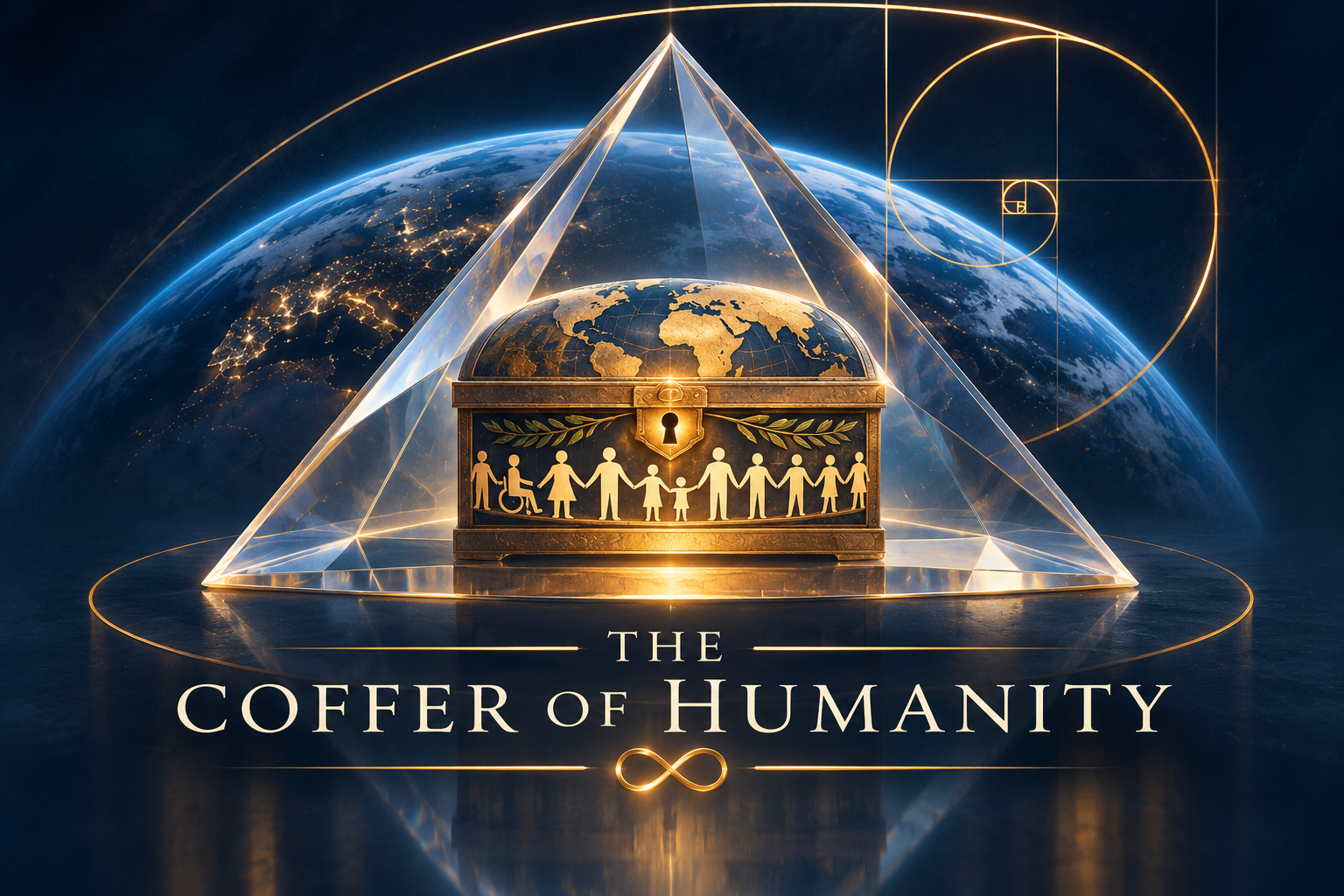
→ The Coffer of Humanity: Preserving Civilisation Beyond Humanity
The Coffer of Humanity is a proposed long-term civilisational memory reserve, conceived beyond the living network of Alexandria Populi. It would safeguard a carefully selected record of humanity’s knowledge, art, histories, languages, achievements, failures, and ethical questions through exceptionally durable preservation. Its purpose is not merely to store objects or data, but to make them intelligible to distant future recipients—even if human civilisation, or humanity itself, has disappeared. The concept therefore includes interpretive guides, contextual explanations, and responsible selection principles. Still speculative, it asks what humanity should preserve, how it could endure, and how another intelligence might understand us.
The Invitation
Alexandria Populi begins with a question:
Can we transform the world's existing library networks into a more democratic, creative and enduring infrastructure for the future development of human consciousness?
The answer will require the collaboration of people and institutions with different forms of expertise, experience and responsibility.
The project is open to those who believe that knowledge should be preserved, creativity encouraged, new ideas given a genuine opportunity to grow, and the benefits of technological development shared more widely.
The future of knowledge should not belong to a few platforms, institutions or privileged groups.
It is a world we can learn to write together.
ALEXANDRIA POPULI
Scientia et Conscientia
Initiative and Concept Development: Filip Firlefijn
Project status: Independent initiative — Concept development and partner exploration
Public concept statement: Version 1.0 — [Mon Oct 19 2026]
The project welcomes exploratory discussions with libraries, universities, research institutions, innovators, businesses, cultural organizations and prospective pilot partners.
Institutional Outreach List
Belgium
Cultuurconnect
Sirris
Wikimedia Belgium
KU Leuven — DigitGLAM
University of Antwerp
Antwerp Management School
Ghent University Library
Groep Algemene Uitgevers
Vlaamse Auteursvereniging
P2P Foundation
Vrije Universiteit Brussel — CLEA
Government of Flanders
Flemish Brussels Policy Department
Flemish Community Commission (VGC)
VGC — Library Support Service (OBiB)
City of Leuven
City of Ghent
City of Mechelen
City of Antwerp
Flanders Department of Culture, Youth and Media
Strategic Advisory Council for Culture, Youth, Sport and Media (SARC)
Creative Europe Desk Flanders
Creative Europe Desk Fédération Wallonie-Bruxelles
Switzerland
University Library Zurich
Wikimedia Switzerland
Bibliosuisse
University of Bern
Orell Füssli Thalia AG
Swiss Federal Office of Culture (BAK)
Swiss National Library
Digital Public Services Switzerland (DVS)
Swiss Federal Chancellery
State Secretariat for Education, Research and Innovation (SERI)
Canton of Bern — Office of Culture
Canton of Bern — Digital Government Office
Municipality of Interlaken
Bödeli Bibliothek — Regional Library Oberland-Ost
City of Bern — Cultural Affairs Department
Canton of Zurich — Cultural Affairs Office
Canton of Vaud — Directorate-General for Culture
Canton of Bern — Directorate of Education and Culture
Swiss Federal Department of Home Affairs (FDHA)
Germany
German Digital Library (DDB)
German National Research Data Infrastructure (NFDI)
German National Library of Science and Technology (TIB Hannover)
German Research Center for Artificial Intelligence (DFKI)
United Kingdom
Open Book Publishers
Open Book Collective
Thoth Open Metadata
Netherlands
Breda University of Applied Sciences
Europeana Foundation
United States
University of Texas at Austin
Digital Public Library of America (DPLA)
European Union
European Parliament — Committee on Culture and Education (CULT)