
ACADEMIC WORK, ESSAYS AND CASE STUDIES
Author’s note:
“While the foundational concepts and arguments were conceived independently, artificial intelligence was deliberately and experimentally integrated into the drafting and development process through an iterative human-led dialogue. Throughout this collaboration, the author has maintained active editorial and conceptual control. This approach serves a dual purpose: to evaluate the practical utility of AI in academic writing as an extension of original human thought, and to invite critical reflection from the reader regarding its efficacy. As an open experiment in scholarly methodology, the resulting text remains fully subject to academic scrutiny concerning how effectively AI can enhance not only contextual richness, but the intrinsic quality of essayistic work.”
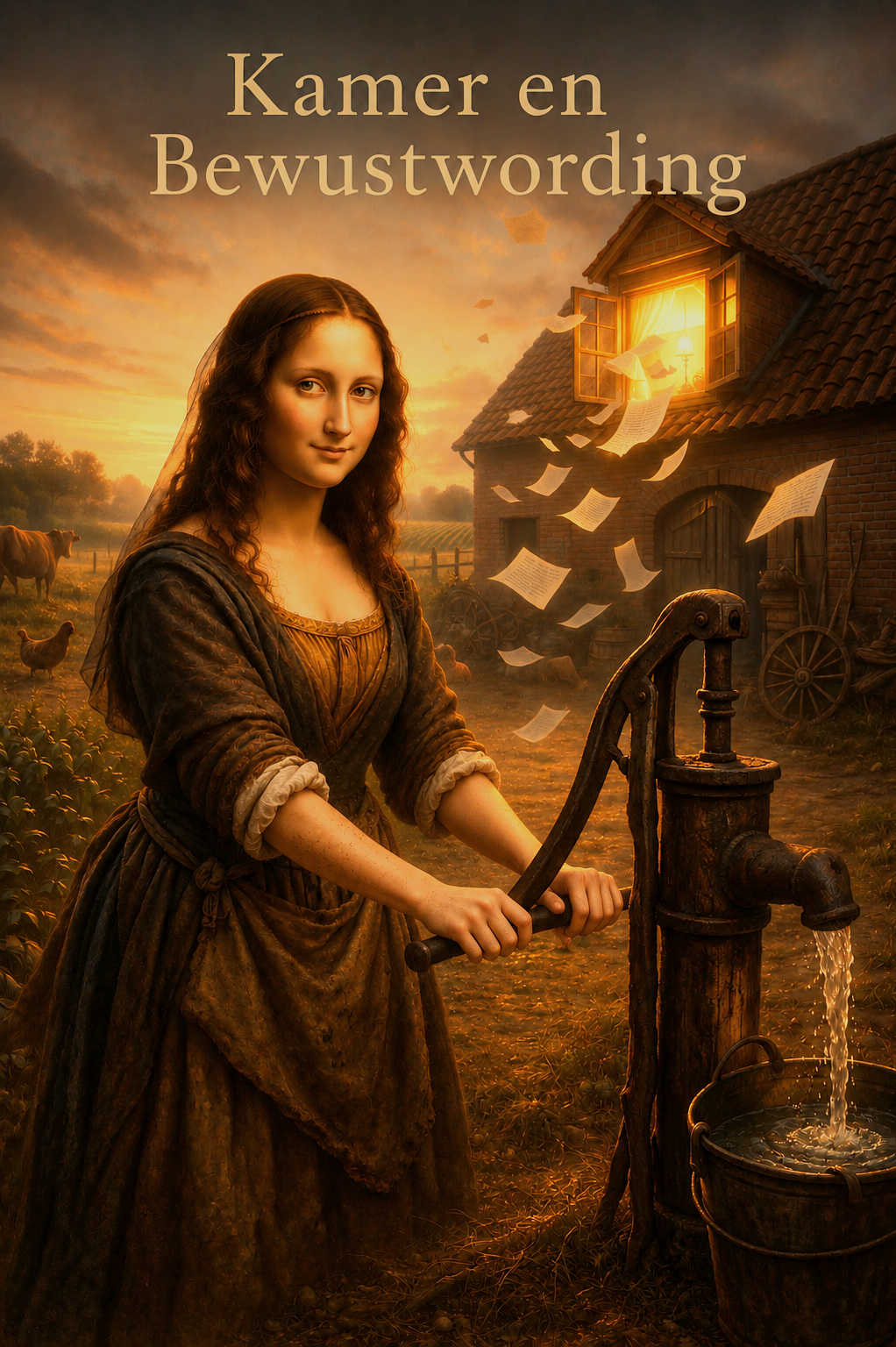
Kamer en bewustwording
Chamber and Consciousness: academic work in Flemish.
“Chamber and Consciousness” is a major research project dedicated to the poetry of the Belgian writer Charles Ducal. It investigates how poetic language can reveal the hidden structures of inner life: guilt, desire, power, embodiment, memory, and transformation. At the centre of the study stands one recurring image—the chamber. The chamber is at once room, psyche, social order, emotional enclosure, and symbolic stage. Through it, poetry becomes a place where consciousness confronts its own limits.
The project combines close reading with broader philosophical interpretation. Rather than reducing poems to biography or theory, it treats them as dynamic forms of thinking. Rhythm, repetition, silence, spatial imagery, voice shifts, and symbolic motifs are read as expressions of psychic and cultural movement. Questions of masculinity, authority, maternal presence, spiritual absence, and the search for incarnation are explored through the evolving architecture of Ducal’s oeuvre.
Spanning multiple collections, the research traces a gradual transformation: from controlled, geometric, often claustrophobic spaces toward more open, earthly, and resonant modes of language. The work draws on phenomenology, psychoanalysis, myth criticism, and poetics, yet remains grounded in the texture of the poems themselves. It seeks to show how literature can think through form—not only through concepts.
What makes this project distinctive is its scale and method. It is both a scholarly dissertation and an intellectual archive: a carefully constructed body of close readings, structural maps, thematic syntheses, and interpretive essays. It is suitable for academic publication, public lectures, university teaching, or modular digital editions.
Ultimately, Chamber and Consciousness argues that poetry is not ornamental culture. It is a laboratory of awareness. In the work of Charles Ducal, language becomes a site where the modern self can be diagnosed, challenged, and perhaps renewed.
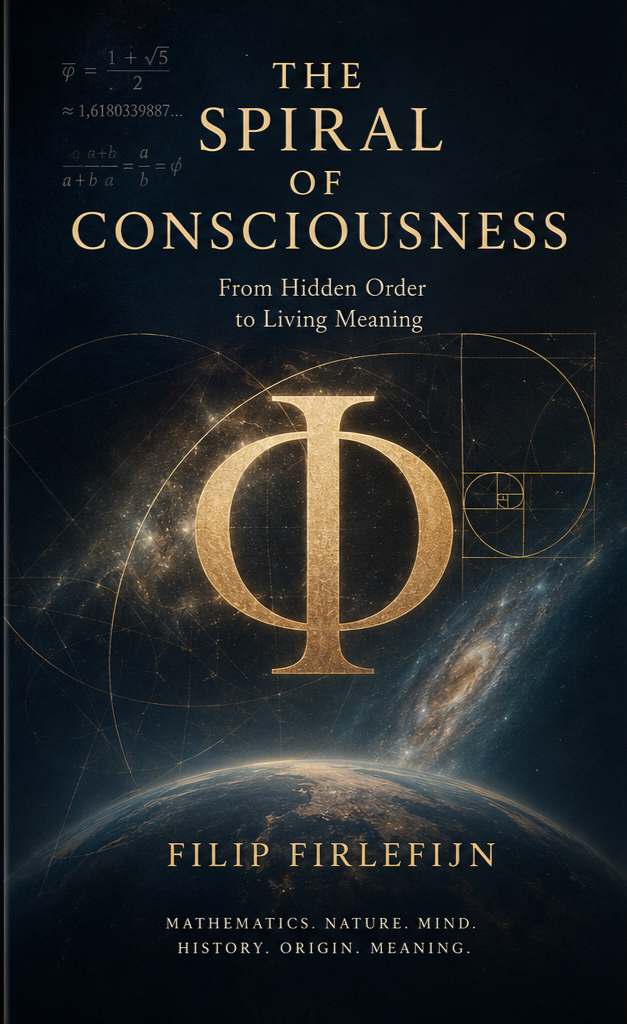
The spiral of consciousness
The spiral of consciousness: academic project in English
“The Spiral of Consciousness” is an ambitious long-form philosophical and literary project that explores one of the oldest and most urgent human questions: how awareness comes into being, transforms itself, and seeks meaning through history, myth, science, and art. Rather than treating consciousness as a purely scientific mechanism or a vague spiritual abstraction, the project approaches it as a living structure—something that unfolds through symbolic forms, perception, memory, embodiment, and culture. The spiral serves as its guiding image: not a closed circle, but a movement of return and renewal in which each stage revisits what came before on a new level of depth.
The work brings together a wide range of sources and traditions: phenomenology, cosmology, sacred geometry, mythology, literature, psychology, architecture, and visual art. It moves freely between thinkers such as Bergson, Whitehead, Gebser, and Bohm, while also engaging the symbolic intelligence of ancient traditions and the creative insights of artists from Leonardo to modern cinema. In this way, the project offers an alternative to fragmented specialization. It proposes a language in which science, imagination, and lived experience can once again speak to one another.
Structured across multiple volumes, The Spiral of Consciousness includes themes such as the birth of awareness, geometry and resonance, darkness and shadow, covenant and crisis, architecture as the search for the mind’s home, mythology as cultural memory, and art as the human face of becoming. Each volume can stand alone, yet together they form a coherent intellectual and poetic architecture.
The project is designed for readers who seek more than information. It invites participation, reflection, and inner movement. It can function as a book series, lecture cycle, essay platform, or interdisciplinary teaching resource. At its heart lies a simple conviction: consciousness is not static. It grows through encounter, through crisis, through form, and through the courage to imagine more deeply what it means to be human.
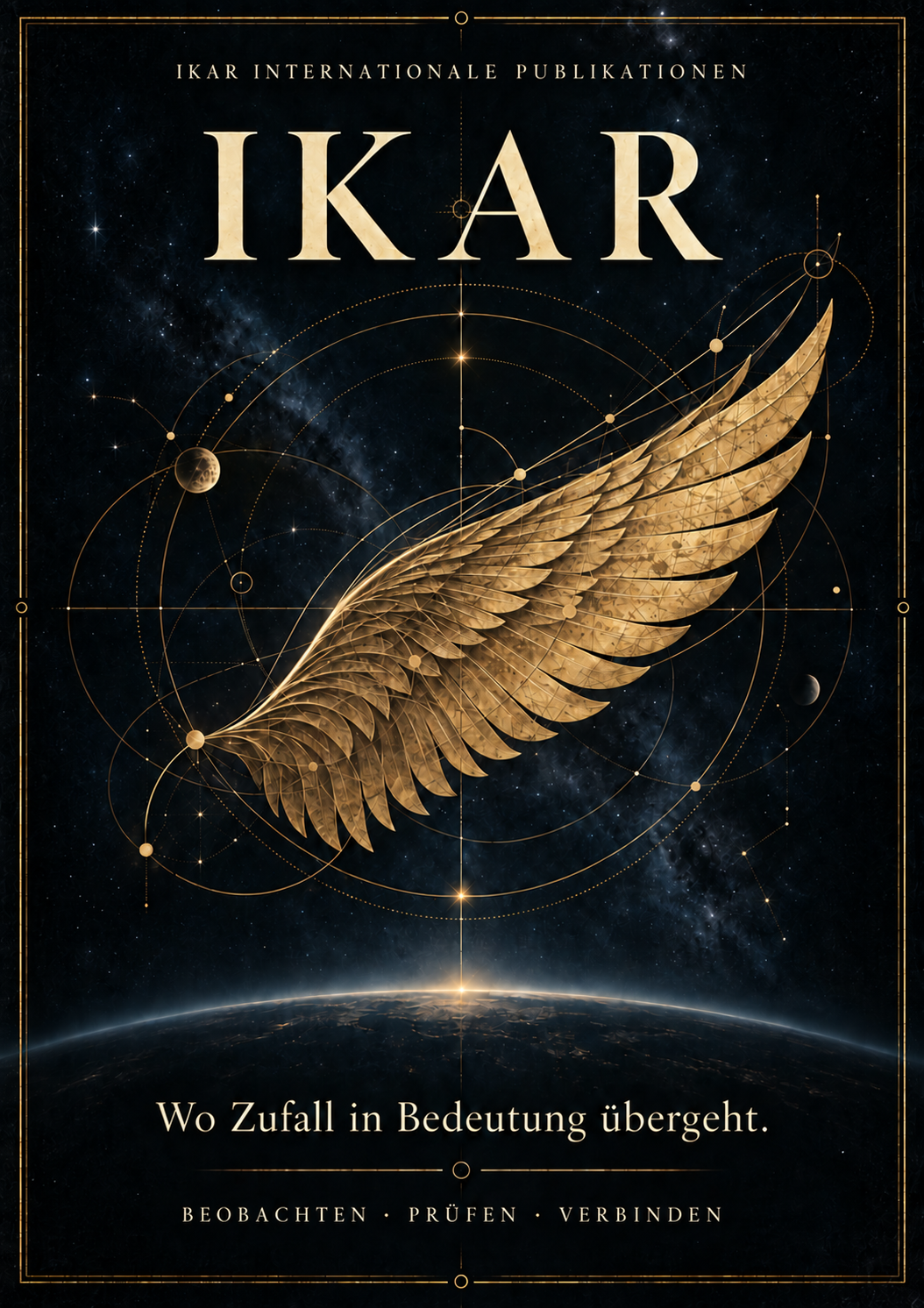
IKAR
Insitut für Koinzidenz, Anomalistik und Resonanz / Institute for Coincidence, Anomalistics and Resonance
The Initiative
IKAR is a research and publishing initiative in development, conceived by Filip Firlefijn to explore coincidences, perceived synchronicities, unusual experiences and recurring cultural patterns.
Its central question is simple: why do certain events, images and ideas appear meaningfully connected—and how can those connections be investigated?
Emerging from the philosophical and cultural research behind The Spiral of Consciousness, IKAR brings together close observation, comparative interpretation and critical inquiry. It offers a framework for examining experiences that can be personally compelling yet difficult to explain or evaluate.
An Open, Critical Approach
Documented observations: what can be established from records, sources and independently checkable information.
Plausible hypotheses: explanations that can be compared, questioned and, where possible, tested.
Psychological and cultural interpretations: how people experience connections and give them meaning.
Further speculation: possibilities that extend beyond the available evidence and are explicitly presented as such.
The aim is to make curiosity more precise while allowing uncertainty to remain visible.
Fields of Inquiry
Coincidence and synchronicity
Examining striking correspondences between events, including experiences described as synchronicity, without presuming a hidden cause.
Cultural repetition and symbolic resonance
Tracing how images, narratives and motifs recur across literature, art, mythology, individual lives and historical periods.
Perception and collective meaning
Exploring how attention, memory, expectation and shared stories shape the patterns people recognise. Concepts such as the collective unconscious can be examined as interpretive frameworks rather than assumed explanations.
Power, media and social influence
Investigating how institutions, communities and media select, amplify or use symbolic associations—and how those associations acquire emotional and political force.
Anomalous experiences
Documenting difficult-to-classify reports with attention to context, source quality, alternative explanations and the limits of retrospective reconstruction.
Research into Publication
IKAR is envisioned as a meeting point between sustained research and accessible public communication. Planned formats include essays, comparative case studies, an organised archive, illustrated publications, talks and moderated conversations.
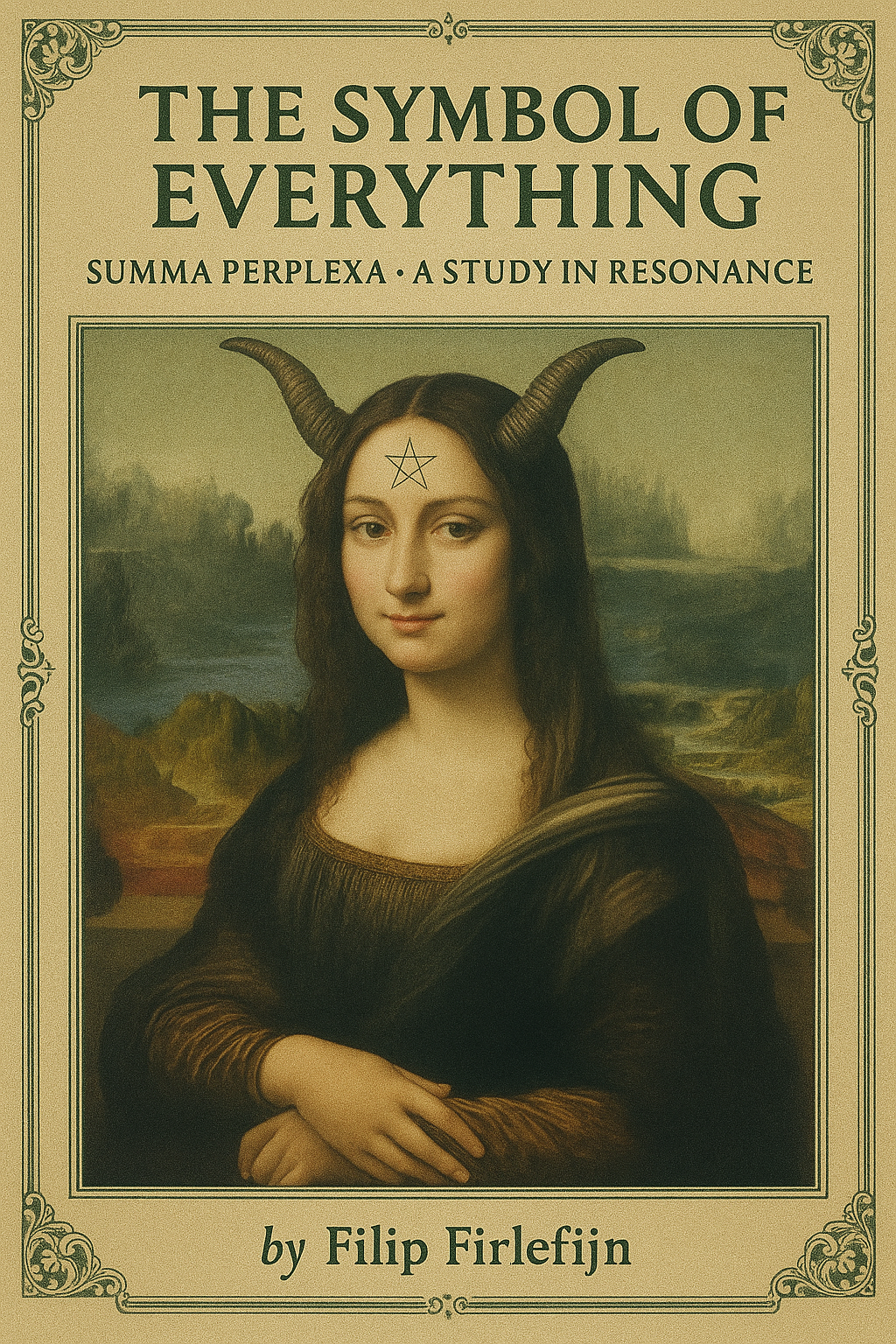
Research of suggestion
unfinished collection of books, with apologies for the delay
“According to principles of suggestion and resonance I started exploring resonant coincidences in a thus psychological but non-personal inverted sense, coincidences that may be called synchronicities but at the same time have a potential to go beyond. It is an antipsychotic search for what can be found if one searches fearlessly and beyond literal science with an open mind to taostic context incorporation.
What I found created a collection of resources so vaste that I could write books for the rest of my life or make endless video content. Yet, the danger would also exist to endanger my true more scientifically oriented methodological work, of course, which with AI becomes even more easy to fully develop. The risk is to become mocked by academia instead of hailed.
The other strange matter besides finding so many interesting “coincidences”, the work that I have been doing for years, is that lately, under a series of consequential events, I am having less and less financial resources while thousands of those documents have mysteriously disappeared as well. The memories in my head may be the only things I have left.
I must even admit to myself that nothing from here on will ever have any normal significance or value again.”
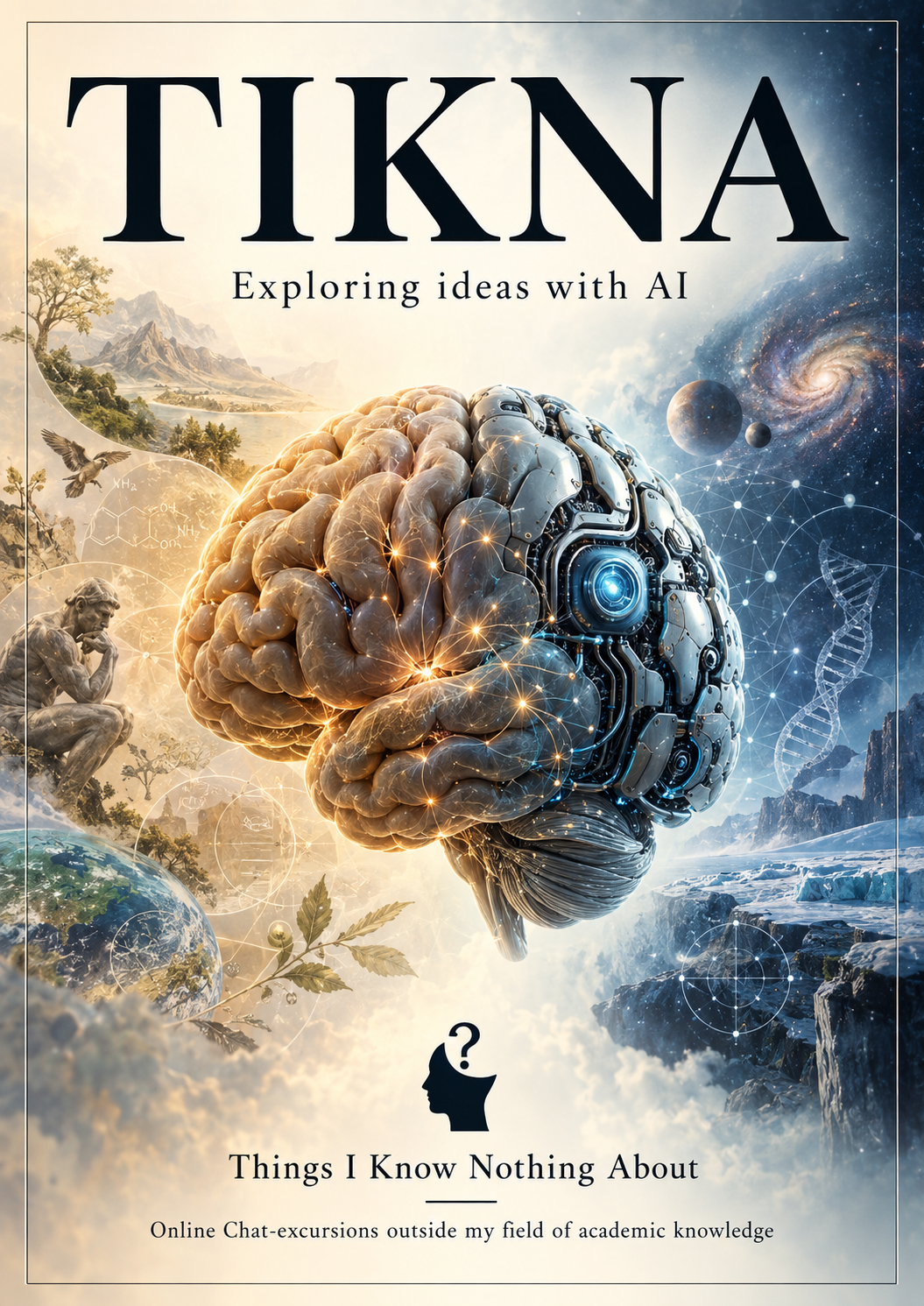
Exploring ideas with AI
TIKNA is a series of explorations (in english) into subjects outside my formal academic field, driven by bold questions about issues that matter. Such issues can be very diverse like cancer, artificial immunity, geological history, technology, consciousness and the future.
The project starts from a simple idea: people can have worthwhile intuitions without having the right degree, laboratory, institutional position, money, time or specialist vocabulary to pursue them. AI can shorten the distance between curiosity and serious inquiry by helping locate research, explain unfamiliar concepts, expose weak assumptions and turn vague ideas into sharper questions.
That does not make expertise unnecessary. On the contrary, the aim is to bring outsider thinking into more disciplined contact with evidence.
The democratic potential is considerable: more people may be able to contribute relevant ideas more quickly. The danger is equally real — an explosion of confident but low-value material. TIKNA therefore treats filtering, verification and uncertainty as part of the method.
Its guiding principle is simple:
Ask questions worth asking, use AI to follow them farther, and never confuse faster exploration with proof.
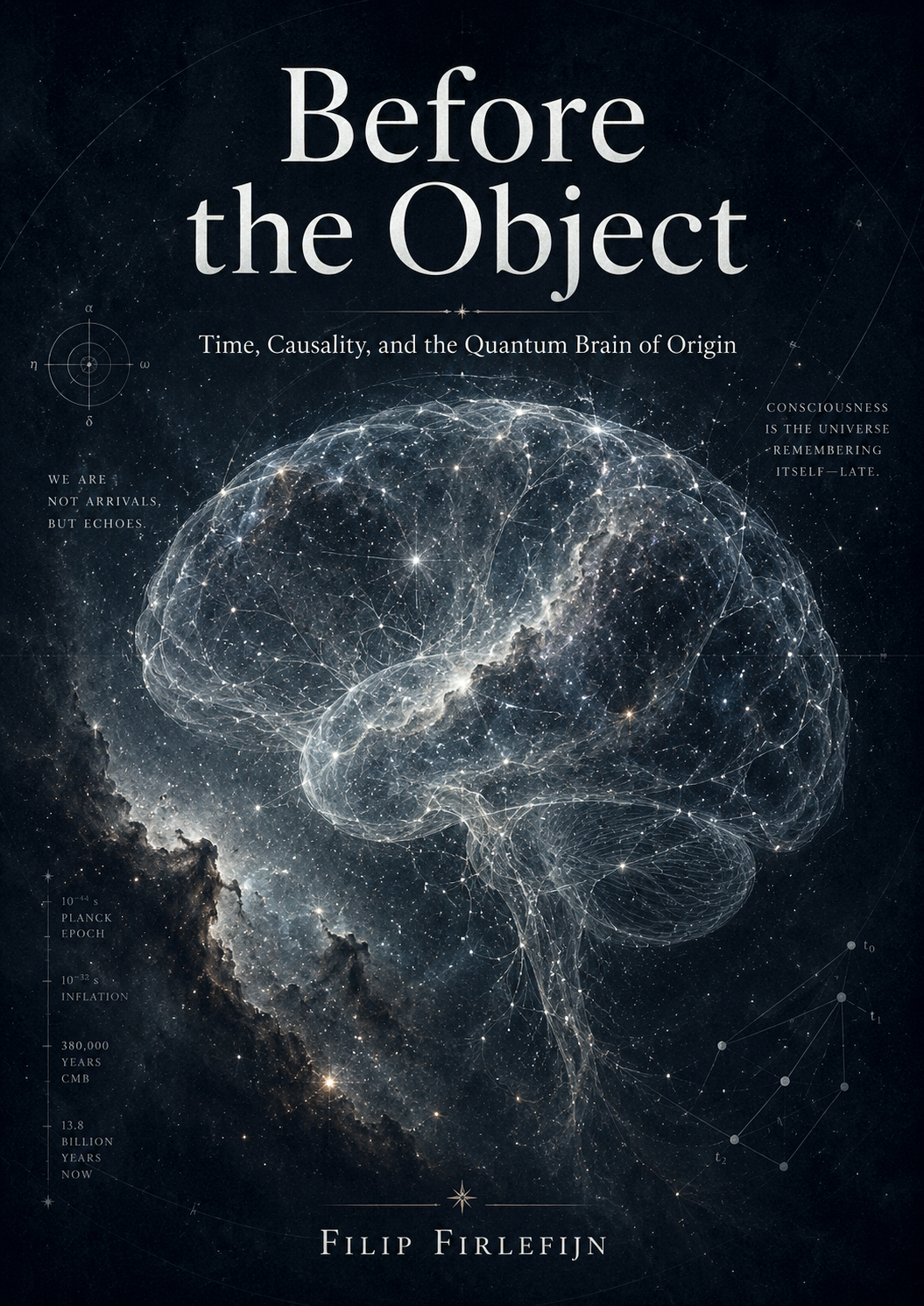
Before the Object: Time, Causality, and the Quantum Brain of Origin
is a phenomenological essay on origin, hidden order, and the limits of object-thinking. It does not propose a scientific theory of the universe, consciousness, or quantum biology. Instead, it asks how an evolved brain, shaped by survival, perception, object-recognition, and tool-making, became capable of thinking beyond the visible world.
The essay begins from the idea that the object-world is not simply given. It is a stabilized form of experience: the world becomes graspable as bodies, things, tools, distances, dangers, and possibilities. Science refines this object-form into measurement, experiment, law, and causality. Yet at the limits of contemporary thought — entropy, quantum reality, dimensionality, non-local correlation, cosmological origin — object-thinking begins to strain.
From this threshold, the essay develops a phenomenology of origins. Time, causality, probability, and coincidence are approached not as ultimate foundations, but as conceptual forms through which hidden order becomes intelligible. The speculative figure of the “quantum brain” is used carefully: not as proof that consciousness is a quantum computer, but as a philosophical image for the brain as a late product of origin, carrying within itself the question of the beginning.
The central intuition is simple: we do not merely think about origin from outside. We are among its delayed consequences. In human consciousness, the universe begins to ask where it came from.
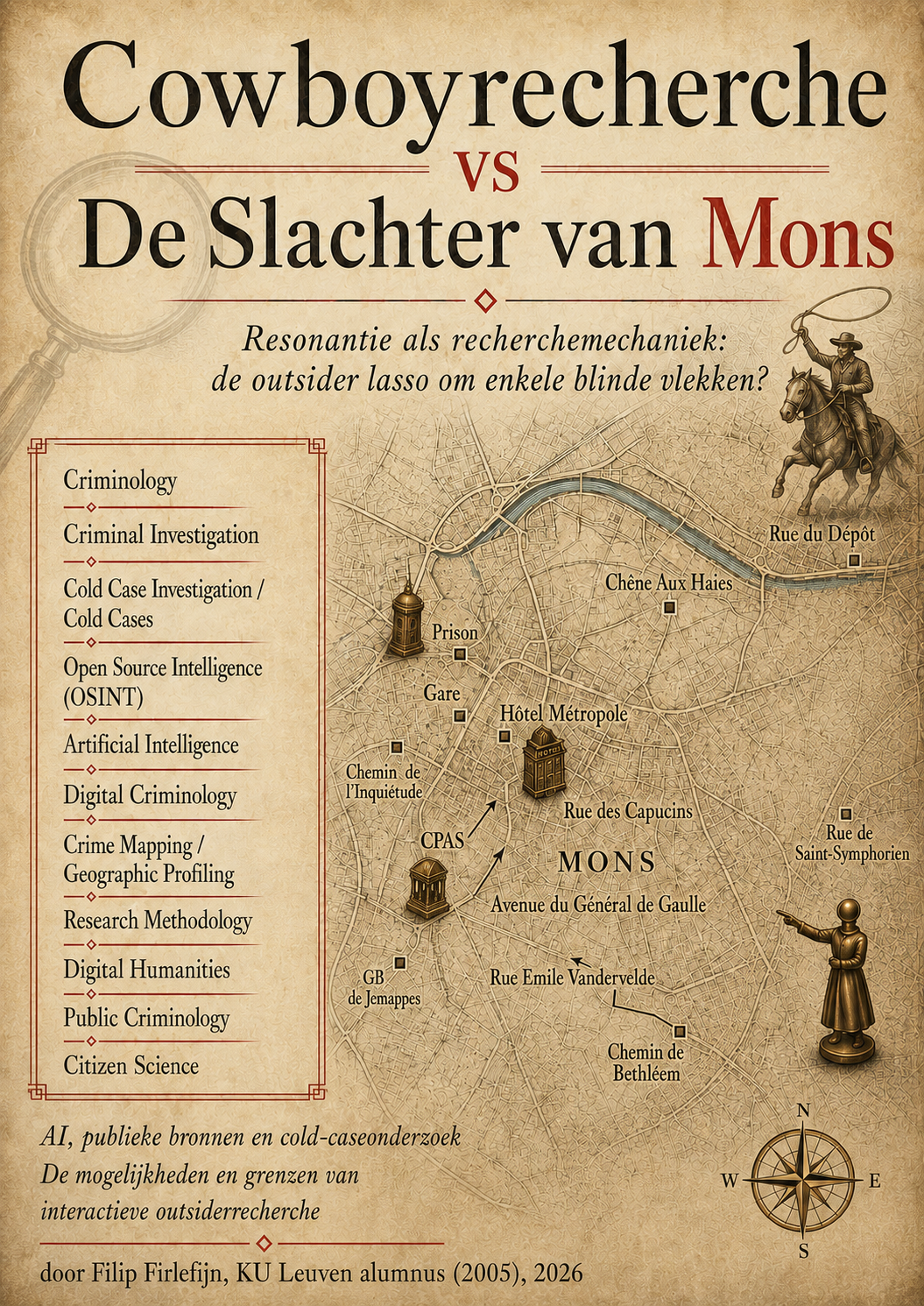
Cowboyrecherche vs. De Slachter van Mons
Cowboyrecherche vs. De Slachter van Mons
Resonance as an investigative method: an outsider’s lasso around the blind spots of a cold case?
Between 1996 and 1997, the dismembered remains of five women were discovered in and around Mons, Belgium. Despite a major investigation involving thousands of leads, witnesses, addresses, vehicles and possible suspects, no convincing chain could ultimately connect the victims’ social worlds to a vehicle, a primary crime scene and a provable offender. The case remains unsolved.
Cowboyrecherche vs. De Slachter van Mons is a Dutch-language investigative study that begins at the limits of the publicly accessible case record. It does not suggest that an outsider equipped with internet access and artificial intelligence can simply solve a thirty-year-old murder investigation. Its question is more difficult: can digital cartography, public archives, historical comparison and AI-assisted research expose connections that deserve renewed scrutiny—or do they merely allow speculation to become increasingly coherent?
The investigation moves from broad geographical possibilities toward an increasingly concentrated microgeography. Industrial corridors, waterways, railway lines, the station district, Hôtel Métropole, psychiatric and social care, criminal milieus, institutional structures and possible work or storage spaces are gradually tested against one another. Several lines eventually converge around Cuesmes, Rue Émile Vandervelde, the N6 and Avenue du Général de Gaulle—not as a reconstructed route, but as an operational landscape whose unusual concentration warrants closer examination.
At the centre of the method lies a strict distinction between confirmed fact, secondary reporting, inference, speculation and resonance. A recurring place, date, person, route or social environment may generate a new research question. It does not become evidence merely because several such resonances begin to form an attractive pattern. The outsider’s lasso may be thrown widely; whatever it catches must still survive historical and documentary verification.
The result is both an investigation into one of Belgium’s most disturbing unsolved murder cases and an experiment in knowledge formation in the age of AI. How do fragments become patterns? When does coincidence become worth investigating? And at what point must a compelling reconstruction remain exactly what it is: a hypothesis?
Understanding “Boon St”:
A scholarly authorial essay (in English) on the critical poetics of adaptation, perspective and realism
“Boon St” is a creative-critical project that unites literature, cinema, and reflective essay writing. Inspired by the work of Louis Paul Boon, it explores how classic texts can be reimagined for contemporary audiences without losing their moral force, psychological depth, or social intelligence. The title suggests both lineage and movement: a street of inheritance, where older voices meet new forms.
At its practical core lies adaptation. Rather than simply transferring a novel to screen, Boon St. treats adaptation as interpretation through image, rhythm, silence, framing, and perspective. Narrative becomes cinematic thought. Characters are not only represented but re-experienced through atmosphere, gesture, and visual tension. The project experiments with multi-perspective storytelling, fractured viewpoints, dark humour, and emotional realism, showing how literature can evolve when translated into another medium.
Alongside screenplay development stands the essay dimension. Here, adaptation becomes a philosophical question: What remains of a work when its form changes? How can fidelity mean creative truth rather than literal copying? What does a modern audience need in order to feel the urgency of older texts? Through these questions, Boon St. becomes more than homage. It becomes a method.
The project also reflects on Belgian and European cultural identity, postwar realism, class consciousness, intimacy, and the fragile ethics of ordinary life—key concerns associated with Louis Paul Boon and still relevant today. It is suited for film schools, literature departments, cultural institutes, festivals, or readers interested in the future of storytelling.
In a time when content is often produced quickly and forgotten quickly, Boon St. argues for another path: careful transformation. It shows that adaptation can be an act of intelligence, respect, and renewal—where the past is not repeated, but made alive again in the present.
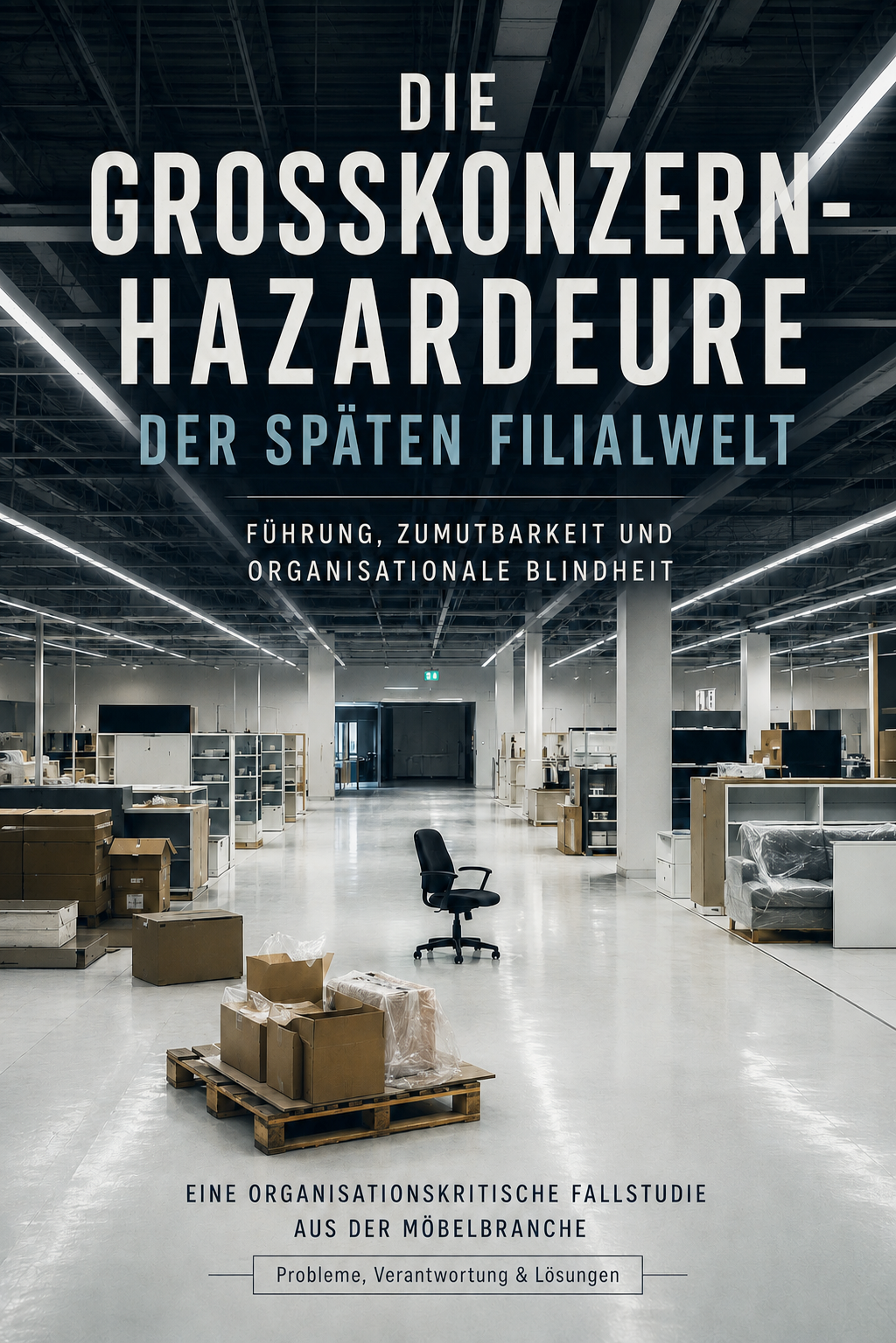
Die Grosskonzern-Hazardeure der späten Filialwelt
Führung, Zumutbarkeit und organisationale Blindheit
Eine organisationskritische Fallstudie aus der Möbelbranche, mit ihre Schikanenfolgen; über Probleme, Verantwortung & Lösungen
The Grand-Corporate Hazard Players of the Late Branch-Store World
Leadership, Acceptability and Organisational Blindness
A German-language organisational case study from the furniture retail sector (about problems, responsibility and solutions)
This German-language study examines how a local branch-store conflict can become a lens for understanding broader failures in modern organisational life. Starting from the concrete reality of a furniture-store opening, the book follows a chain of pressures: premature operational readiness, insufficient resources, incomplete training, warehouse and spatial logistics, responsibility without adequate power, shadow communication, distorted overtime records, misleading system data, exclusion dynamics, termination, and the long aftermath of a damaged professional separation.
The central thesis is that an organisation becomes dangerous when it first creates or tolerates structural overload, then lets local leadership compensate for it, and finally reads the traces of that compensation as personal leadership failure. The study does not present itself as a legal accusation or a personal grievance, but as an organisational-ethical reconstruction: not simply “who is guilty?”, but how responsibility was shifted, simplified, documented, personalised and ultimately carried by one professional biography.
The branch store appears here as the concrete site where central planning, regional management, digital systems, economic deadlines, warehouse reality and human endurance collide. What may look like a local personnel issue becomes a wider diagnosis of organisational blindness: the tendency to see metrics, complaints and administrative traces more clearly than the working conditions that produced them.
The book also asks what happens after termination. A separation does not end with the last working day. It continues through references, job applications, unemployment procedures, self-confidence, reputation, and the question of whether an organisation truly learns—or merely removes one person while leaving the damaging patterns intact.
Written in German, this study combines practical workplace analysis with a broader reflection on responsibility, fairness and organisational learning in late corporate branch-store culture.