BOON ST
A play for the screen
Presentation video
-
Presentation video -
Inspired by Louis Paul Boon’s Menuet
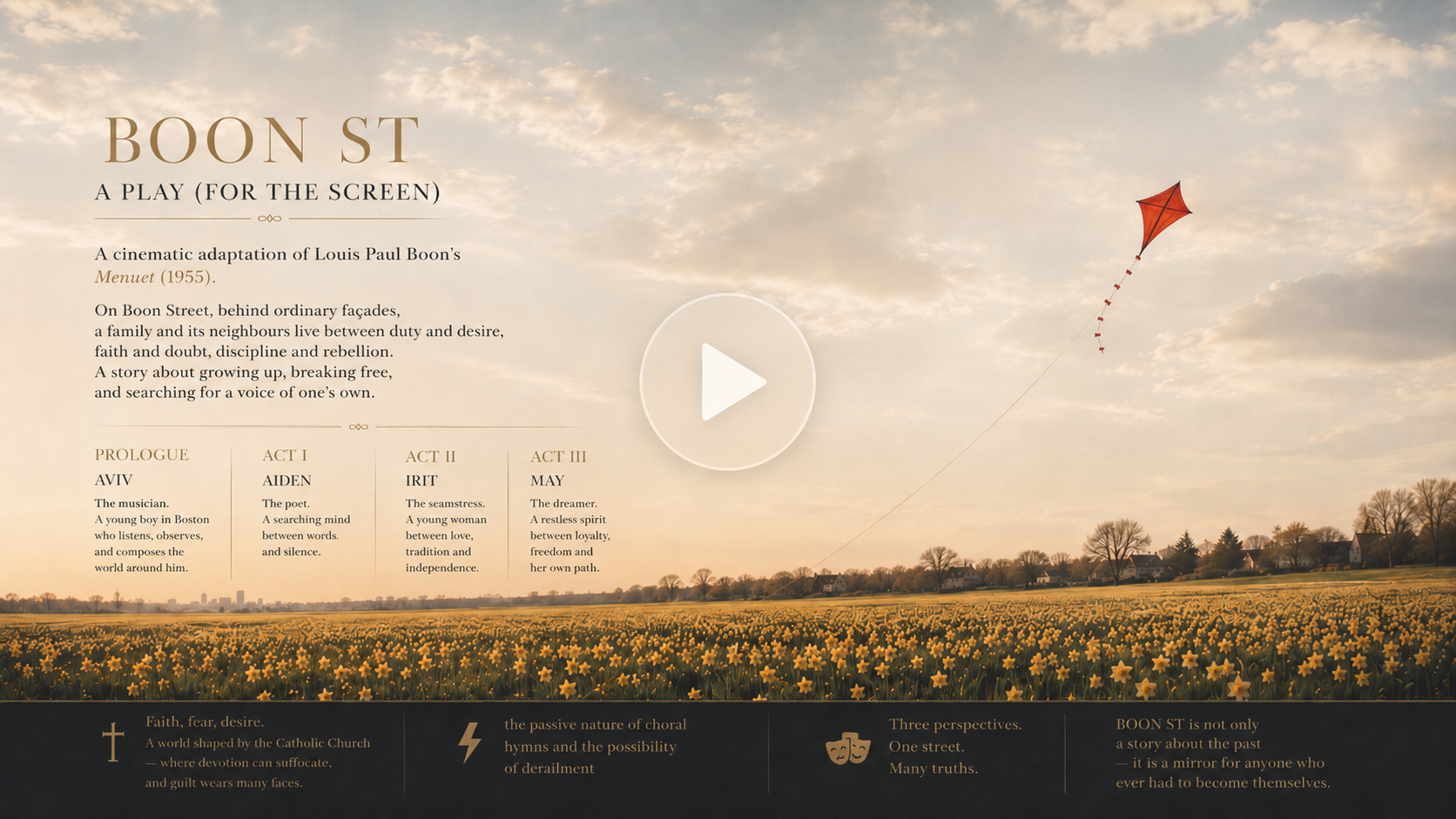
Boon St is an English-language literary screenplay by Filip Firlefijn, freely based on and developed from Louis Paul Boon’s 1955 novel Menuet. Conceived initially for the screen but deliberately written with enough literary and dramatic substance to be read independently, it is at once an adaptation, a psychological drama, a formal experiment in point of view and a reflection on how much of another person’s life anyone can ever really know.
The project began with a deceptively simple question: what happens when one of the most distinctive structural qualities of a literary novel is not merely illustrated on screen, but translated into cinematic form?
Boon’s Menuet does not derive its power only from what happens. Its deeper tension lies in the distance between people who inhabit the same world but do not inhabit the same understanding of it. Three perspectives coexist without ever becoming one completely transparent truth. The title itself evokes triple time: a minuet as a dance in three, a formal rhythm that quietly corresponds to the novel’s tripartite architecture. That combination of raw realism, poetic design and structural experiment was one of the principal reasons for choosing the work as the point of departure for Boon St.
The adaptation therefore does not attempt to reproduce Menuet scene by scene. It asks instead what its central artistic problem might become in another medium, another language, another country and another historical constellation.
One reality, several positions inside it
The main body of Boon St is built around three extensive perspectives: Aiden, Irit and May. Certain events return. A gesture that seems incidental from one position may acquire another meaning when encountered again. Something noticed by one character may remain entirely invisible to another. The physical event remains the same, but access to it changes.
That distinction is fundamental to the screenplay.
Boon St is not constructed around the idea that everybody possesses a different reality. Rather, the characters move through one material reality from irreducibly different positions within it. They see different parts of the same event. They hear different things. They arrive too early or too late. They interpret what is available to them through memory, temperament, attraction, resentment, fear, expectation and incomplete knowledge.
The spectator therefore does not simply receive information. The spectator has to recontextualize it.
A scene can remain physically identical while its emotional meaning changes because another perspective has made something visible that was previously unavailable. Conversely, the audience may sometimes know more than the character who is looking directly at what appears to matter.
This is where the screenplay’s experimental form and its realism become inseparable. Its structure does not stand above the characters as a clever formal puzzle. The structure is itself an argument about human experience.
The older accompanying essay describes precisely this tension: the three relatively enclosed perspectives point toward the possible reach of truth while simultaneously revealing how much remains inaccessible to each individual participant. The resulting problem extends even to the narrator or creator, because no real human being occupies a genuinely omniscient position.
From Flanders to postwar America
The transformation of Menuet also involved a radical displacement.
Boon St is written in English and relocates its principal dramatic world to the Boston area. The change was never intended merely as a cosmetic Americanization of a Flemish novel. It opened another historical and cultural field in which the original work’s concerns could resonate differently.
The Second World War and its aftermath remain present not as historical decoration but as pressure exerted upon private life. Memories of war, inherited histories, Jewish identity, American postwar normality, domestic reconstruction and the growing cultural changes of the twentieth century exist beside the ordinary material world of houses, gardens, radios, bicycles, newspapers, household work and neighborhood routines.
This produces one of the screenplay’s basic tensions: history is immense, yet life is experienced locally.
A catastrophe may belong to world history while its consequences enter a kitchen. Political events coexist with marriage, work, illness, desire, boredom, misunderstanding and the daily struggle to keep a household functioning. The adaptation’s American setting therefore allows historical distance and domestic immediacy to inhabit the same dramatic field.
The earlier essay explicitly regarded the relocation as a way of strengthening the implications of the original postwar atmosphere: even somewhere such as Boston, far from the European battlefield, war and its consequences can leave absences and unknowable regions in the stories people construct about themselves and others.
A domestic drama with a much larger horizon
At its most immediate level, Boon St remains a story about people living close together.
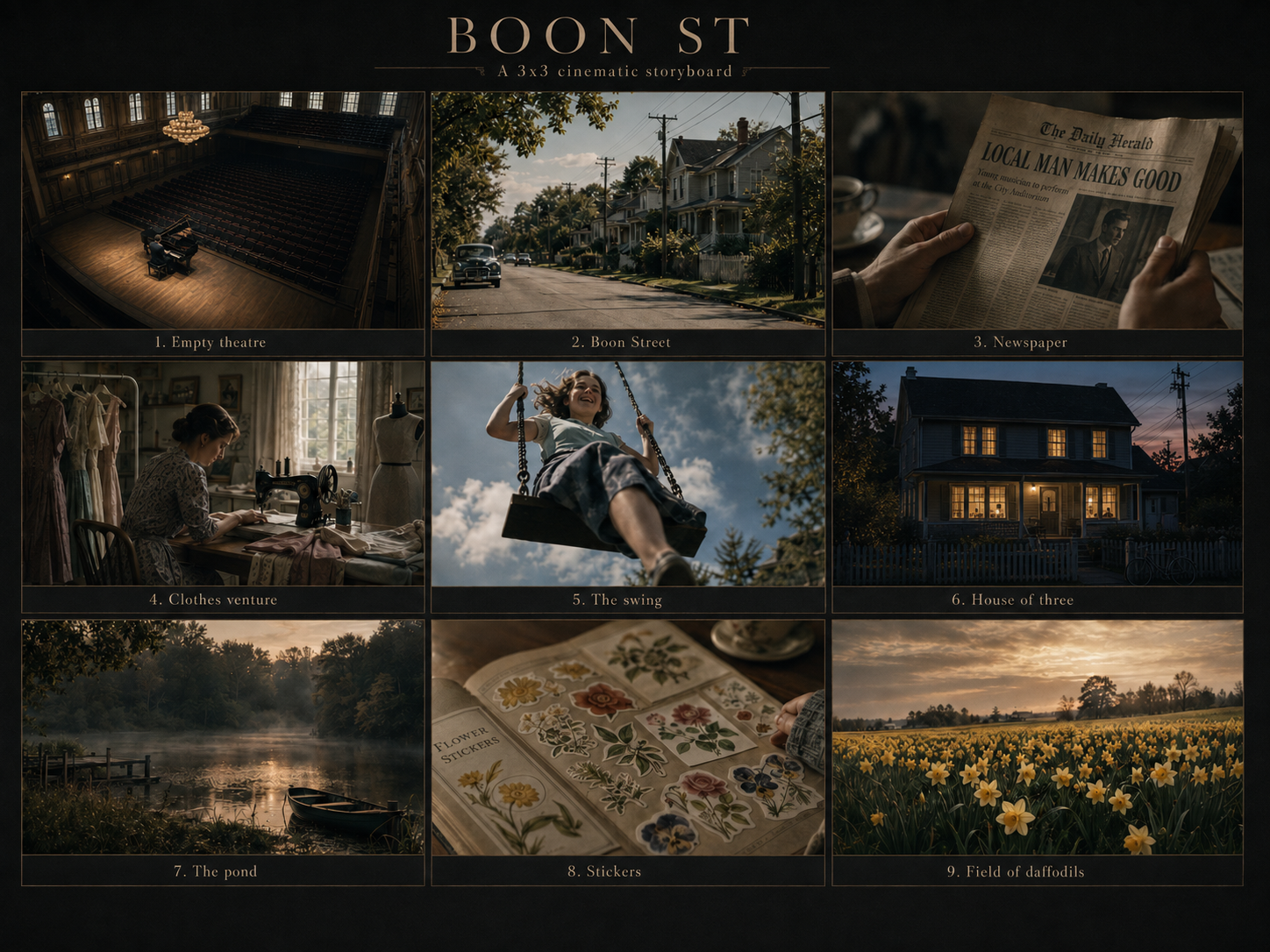
A house and its surroundings form the principal center of gravity. Rooms, doors, windows, stairs, a garden, a nearby road and the surrounding landscape repeatedly determine what can be seen, heard or misunderstood. The screenplay is intensely attentive to objects and ordinary actions: clothes, food, newspapers, household tasks, music, bicycles, small possessions and seemingly unimportant gestures acquire significance because different characters encounter them differently.
Nothing needs to announce itself as a symbol before it can become meaningful.
The result is deliberately intimate. Yet the small scale should not be confused with a small subject. Through those domestic spaces the screenplay moves toward questions of marriage, sexuality, authority, gender, memory, guilt, generational difference, religion, violence, loneliness, social expectation and the difficulty of recognizing another person as something more than a figure inside one’s own story.
The house becomes, in that sense, almost an epistemological space: people are physically close and nevertheless remain astonishingly difficult to know.
Realism without omniscience
One of the larger questions behind Boon St concerns realism itself.
Traditional narrative can easily give a reader or spectator an impossible privilege: the ability to see everybody, understand motivations, connect causes and consequences and eventually survey the whole design. Real life does not offer that position.
Boon St deliberately uses dramatic construction while remaining suspicious of the authority construction can suggest.
Its characters possess incomplete memories. They misunderstand one another. They occasionally interpret images without having access to the events that produced them. They may correctly sense that something matters while being wrong about what it means. Even retrospective knowledge does not necessarily create a complete picture.
The screenplay therefore does something apparently paradoxical: it uses an elaborate structure not to demonstrate mastery over reality, but to expose the limits of mastery.
This concern already occupied the original project’s long accompanying essay. There the impossibility of genuine omniscience becomes part of the work’s realism rather than an obstacle to it: acknowledging that a narrative is constructed by a non-omniscient human consciousness can make that construction more, rather than less, honest.
That idea also explains the unusual presence surrounding the three principal perspectives.
A fourth character appears outside their central triptych. Through music, memory and reflection, his position gradually expands the screenplay’s question from What happened? toward something considerably more difficult:
What does it mean to tell what happened when no one could ever have known all of it?
The fourth perspective
The prologue introduces Aviv Sanftleben, a composer encountered decades after the central period of the story.
His presence deliberately changes the scale of the work. Music, autobiography, memory, artistic creation and the problem of narrative knowledge enter a dramatic world that will subsequently become much more concrete and domestic.
That fourth position does not simply explain the three others. On the contrary, it introduces another limitation.
The older version of the project described the resulting paradox quite openly: Aviv appears connected to a story that exceeds what he himself could possibly have known. Instead of concealing that impossibility, Boon St turns it into part of its design.
The prologue therefore functions less as a key that solves the screenplay than as a tuning instrument. It prepares themes that the main story will make physical: incomplete perspective, artistic construction, memory, music, war, the desire to create coherence and the resistance of actual life to that coherence.
The spectator is given a framework—and then invited to discover where that framework fails.
Why music matters
Music is not an ornamental layer in Boon St.
Its presence grows out of Menuet itself. A minuet is a dance in triple time, and the original novel’s three perspectives can consequently be understood as participants in a slowly developing literary dance.
The adaptation retains that musical principle while broadening it.
Rhythm appears in repetitions, returns, missed encounters and changes of tempo. Certain actions recur from another angle. A scene may accelerate because a character understands too little, or slow because a small gesture suddenly becomes important. Music on radios belongs to everyday life while also becoming part of the larger emotional architecture.
The screenplay does not ask the audience to decode a rigid musical system. The musical analogy is more useful than that. Characters move independently but affect one another. Motifs return altered by context. Dissonance can become meaningful without being resolved. Repetition is never quite repetition because the listener has changed.
The old essay describes the ambition in almost compositional terms: an intricate but solid structure in which realism, plot and music could work together, balancing character, emotion, rhythm and tempo. It also places the project in conversation with structurally adventurous cinema, mentioning works by Kurosawa, Kubrick, Tarantino, Nolan and others, while identifying Stanley Kubrick’s precision, timing and use of music as a particularly important source of inspiration.
The result, however, is not an imitation of any of those filmmakers. The structural origin remains unmistakably literary.
An adaptation that keeps its source visible
The title Boon St is deliberately simple.
It sounds like an address.
That is important because the screenplay is rooted in place, action and ordinary physical reality. Yet the name also keeps Louis Paul Boon present. The adaptation does not conceal its origin or pretend that the source text has merely supplied a plot that can subsequently be discarded.
Instead, the relationship between source and adaptation becomes part of the new work.
The accompanying essay argues that a successful transformation may preserve the conceptual richness of literature without reproducing its original techniques literally. A stream of consciousness does not have to become a voice-over. A literary structural device does not have to survive in its original grammatical form. The question is what cinematic structure can perform an equivalent—or potentially even newly productive—function.
That is the wager of Boon St.
Its relationship to Menuet is therefore simultaneously faithful and disobedient.
Faithful to the importance of perspective.
Faithful to ambiguity.
Faithful to the uncomfortable coexistence of realism and poetic construction.
Faithful to Boon’s refusal to turn human beings into morally tidy abstractions.
But disobedient in setting, historical elaboration, characterization, dramatic scale, cinematic architecture and the additional frame through which the original three-part structure is reconsidered.
The adaptation attempts to protect the generative principle of the source rather than its surface.
Boon Street
There is another reason for the title.
A street is an unusually modest designation for a work containing such an elaborate architecture. It brings everything back to somewhere one could actually live. People have addresses. They pass one another. They enter and leave houses. They look through windows. They know neighbors without necessarily knowing them very well.
The old essay repeatedly returns to this strength of the title: its directness anchors a structurally complicated work in a concrete setting, while its reference to Boon keeps the source inside the adaptation’s identity.
There is also a playful relationship between Boon St and Boston—the letters themselves almost seem to rearrange the adapted origin into its new American location. The essay further explores the many possible resonances of “boon”, “street” and even “saint”, without reducing the title to a single pun.
The name should therefore remain slightly ordinary and slightly strange.
Like the story.
Between literature and cinema
Although conceived as a screenplay, Boon St has always occupied a space between forms.
It can be approached as a film project, but it has also been written to sustain reading. Its extended scene descriptions, recurring visual motifs, large architecture and attention to prose allow the screenplay to function as a literary object in its own right. Earlier editions were consciously published for that reason: the author considered the screenplay readable as a dramatic work even before any eventual screen realization.
That hybrid identity is intentional.
Cinema can reveal relationships through framing, editing, sound, duration and repetition. Literature can make the reader more consciously aware of the act of interpretation. Theatre intensifies presence and spatial limitation.
Boon St is interested in the border where those capacities meet.
Its long development has therefore not been a process of turning a literary text into a conventional screenplay by stripping away everything considered “unfilmable”. The project has instead asked how literary density might become filmically productive.
How can prose become mise-en-scène?
How can perspective become editing?
How can repetition become suspense?
How can an object acquire meaning without an explanatory narrator?
How can an audience be allowed to misunderstand something at exactly the same moment as a character?
And how can a screenplay preserve ambiguity while still remaining physically exact?
Those questions are not supplementary to Boon St. They are part of its creative engine.
The discipline of overlapping perspectives
One consequence of this architecture is an unusual demand for continuity.
When an event belongs to more than one perspective, the physical event cannot conveniently reinvent itself for dramatic effect. A hand must be where it was. A person entering a room must enter at the same moment. A radio heard in one perspective must remain available to the others. What differs is not the objective event but attention, knowledge and interpretation.
This produces a form of dramatic counterpoint.
One character may experience a moment primarily as embarrassment, another as attraction, another as danger. One notices an object while another notices a face. Someone may hear a sentence without understanding its importance; another already knows what preceded it.
The overlapping scenes therefore ask the audience to do something active but natural: to remember.
Meaning accumulates.
The screenplay becomes less a sequence of revelations than an expanding field of relations.
A postwar story that refuses to remain in the past
The historical setting does not make Boon St a period piece in the narrow sense.
Its questions remain contemporary.
How much do we actually know about the people closest to us?
How quickly does observation become interpretation?
When does interpretation become conviction?
How much of identity consists of narratives we have built from incomplete evidence?
What happens when private experience intersects with historical violence?
Can a story acknowledge the impossibility of complete knowledge without surrendering the attempt to understand?
And can art use form not to impose certainty, but to make uncertainty more precise?
The screenplay does not offer an abstract answer to those questions. It places people in situations where the questions become unavoidable.
Humor, discomfort and the refusal of moral tidiness
Despite its philosophical architecture and difficult subjects, Boon St is not conceived as an austere theoretical exercise.
Boon’s own combination of seriousness, rebelliousness, vulgarity, irony and humor remains an important point of reference. The old essay repeatedly insists that the work should be capable of carrying disturbing material without losing wit, attitude or moments of lightness.
That tonal instability matters.
People can be ridiculous while suffering.
They can be intelligent and badly mistaken.
They can behave selfishly without becoming monsters.
They can be tender without becoming innocent.
A comic moment can sit dangerously close to catastrophe.
Such collisions prevent the screenplay from becoming a diagram of moral positions.
Its characters are allowed to remain people.
No final omniscient view
Eventually the spectator will know more than any single principal character.
But even that does not create God’s-eye knowledge.
This distinction is crucial.
As the three perspectives accumulate, uncertainty is reduced in some areas and intensified in others. Motives become clearer while causality becomes more complicated. Events that initially appeared simple develop depth; things that seemed meaningful may prove accidental; apparently insignificant details may acquire weight.
The point is not that truth does not exist.
The point is that access to truth has conditions.
That makes Boon St fundamentally different from a narrative in which perspective is only a trick used to conceal a final solution. The accumulation of viewpoints can solve local mysteries, but the larger human problem remains.
The old theoretical essay formulates this as a problem of narrative authenticity: a story that acknowledges the limits of its own knowledge may ultimately be more realistic than one that silently assumes perfect authority.
An open work
Boon St has existed in several forms since work on the project began in earnest in 2014. It was first published together with an extensive essay in 2018, and the screenplay has subsequently continued to evolve. The current production-oriented version represents a substantial new editorial and dramaturgical stage rather than a simple reprint of the earlier text. The original essay itself records both the long development of the project and the decision to publish a screenplay that was nevertheless conceived for eventual dramatic realization.
That long development seems appropriate for a project whose central concern is perspective.
Every return to the work raises the same question that governs its characters:
What becomes visible now that was not visible before?
The answer has never required replacing the work’s original identity. It has required sharpening it.
The current screenplay retains the fundamental architecture that made the project unusual from the beginning: an extended prologue, three major character perspectives and an epilogue, with the dramatic material progressively gaining different meanings according to who is present, who is looking and what they can know.
Why Boon St?
Because adaptation can be more than retelling.
Because cinematic form can think.
Because perspective is not simply a camera angle.
Because realism becomes more interesting, not less, when it admits its limits.
Because the same room can contain several stories at once.
Because an event and an image of an event are not necessarily the same thing.
Because people participate in histories they cannot survey.
Because music can exist in a screenplay even before a score has been written.
Because literature can enter cinema without surrendering its intelligence.
And because sometimes the most complicated questions can begin with nothing more complicated than an address:
Boon St.
About the source and the project
Boon St is based on and inspired by Menuet (1955) by the Belgian writer Louis Paul Boon. Rather than attempting a literal transcription of the novel, the screenplay develops its perspectival and structural possibilities through a new postwar American setting, additional narrative material and an expanded cinematic architecture.
The screenplay is written in English by Filip Firlefijn, a KU Leuven alumnus in Dutch and English literature. Earlier editions combined the dramatic text with the extensive essay Understanding the True Depth of “Boon St”, in which the adaptation, its relation to Boon, its musical and perspectival structures and its ideas about realism and narrative knowledge are examined in detail. The author originally expected a short introduction to be sufficient, but the structural and thematic complexity of the adaptation eventually demanded a much larger critical text.
The screenplay itself, however, is designed to stand without that theoretical apparatus. The earlier preface explicitly stresses that the work should function independently, while deeper knowledge of its construction can enrich subsequent readings.
In other words: the essay explains the architecture. The screenplay has to make you feel it.